Osseointegration: how an implant becomes part of the jaw
An implant is screwed in tight on the day of surgery, but that grip is mechanical. Over the following weeks bone remodels around it and takes over. Understanding the hand-over explains most of the rules you are given after surgery.
 Medically reviewed by Dt. Hüseyin Yavuz Özbek, implant surgeon · Updated October 2026
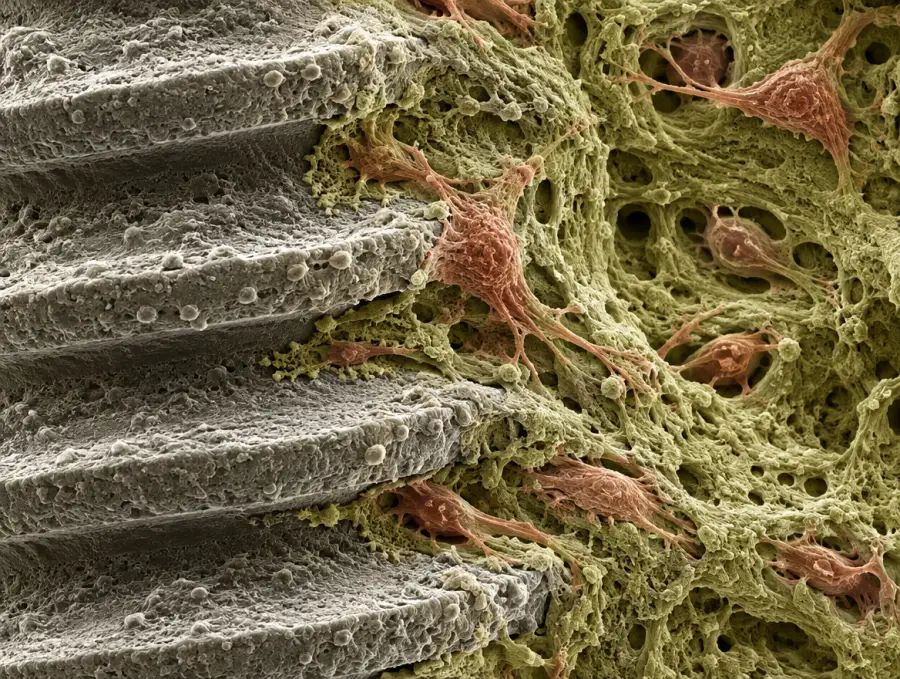
Osseointegration is the direct bonding of living bone to an implant surface. On the day of surgery the implant is held by friction against the bone it was screwed into (primary stability). Over the next weeks some of that bone is resorbed and replaced by new bone growing onto the implant (secondary stability). Measured stability is usually lowest around three weeks and recovers after that, most slowly in soft bone.
A short history of a big idea
The word osseointegration comes from the Swedish orthopaedic researcher Per-Ingvar Brånemark, whose group found in the 1950s and 1960s that titanium placed in bone became firmly attached to it. In 1977 his team published ten years of experience treating people who had lost all their teeth with titanium implants carrying fixed bridges (Brånemark et al., 1977, in the sources). Full-arch implant dentistry grew directly out of that work.
The core finding still holds: under the right conditions, living bone grows into direct contact with a titanium surface, with no soft tissue layer in between, and that contact can carry chewing forces for decades.
Two kinds of stability
Primary stability: the day-one grip
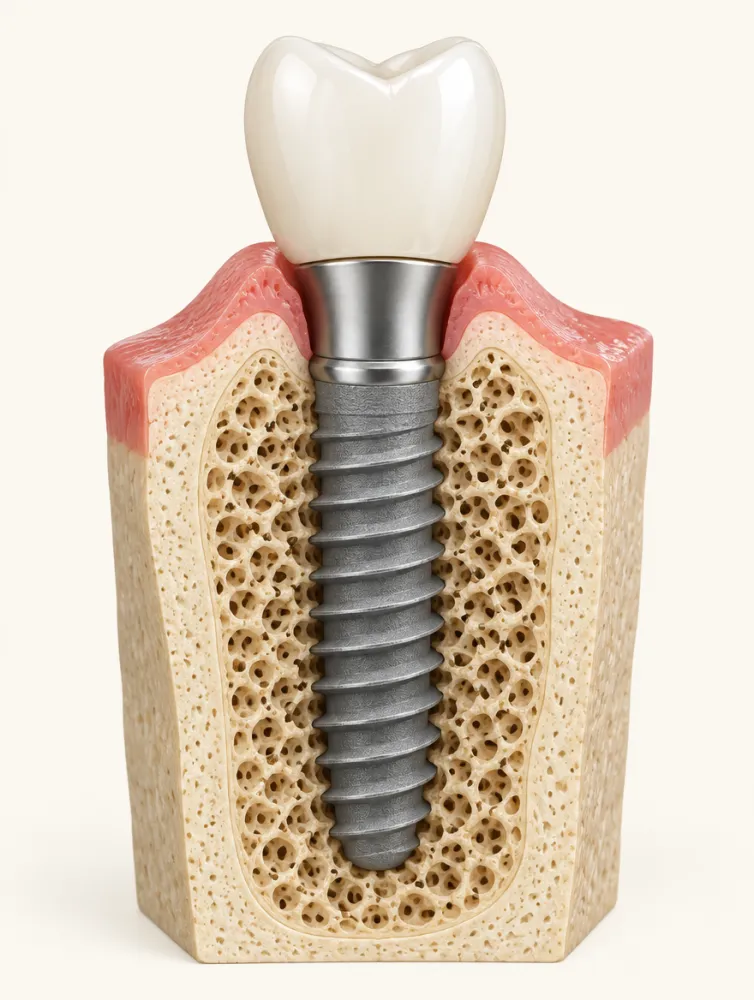
When the surgeon drills a slightly undersized hole and screws the implant in, the threads wedge against the bone. That friction is primary stability. It is measured as insertion torque (in newton-centimetres) or with a resonance device that gives a stability score. Dense bone gives more grip; soft bone gives less.
Secondary stability: the biological bond
Secondary stability comes from new bone forming on the implant surface and remodelling into mature bone. It builds over weeks and months and is what keeps an implant in place for the long term.
The problem is that the two do not simply add up. The bone squeezed by the threads on day one is damaged by the pressure, and the body clears it away before replacing it. For a while, primary stability is falling before secondary stability has fully taken over.
What happens, week by week
Much of what we know about the earliest phase comes from a carefully designed animal study. Researchers placed 160 implants with a roughened surface in 20 dogs and examined them from two hours to twelve weeks (Berglundh et al., 2003).
- First hoursBlood clotThe space between bone and implant fills with a clot, which becomes the scaffold for healing.
- DaysGranulation tissue and provisional matrixThe clot is replaced by soft repair tissue rich in new blood vessels and bone-forming cells.
- Week 1New bone startsWoven bone appears, both growing from the cut bone and directly on the implant surface.
- Weeks 1–2The swapBone that held the threads tight is resorbed and replaced with new bone. In the study the implants stayed clinically stable throughout.
- Weeks to monthsRemodellingWoven bone is replaced by stronger lamellar bone and marrow; the bond keeps adapting to chewing forces for life.
A small human study tracked this with resonance frequency measurements on 27 roughened implants in the back of the jaws. Stability was lowest at three weeks in every bone type. Soft (type 4) bone showed the biggest drop, 8.6% from day one to week three, and the biggest recovery, 26.9% from week three to week ten (Barewal et al., 2003). By week five the differences between bone types had disappeared.
The "soft food" and "no heavy chewing" instructions after surgery are aimed at the dip. They protect the implants while the hand-over from mechanical grip to living bone is happening.
Soft bone, dense bone
Bone quality shapes every stage. Dense bone grips well on day one but has fewer blood vessels; soft bone grips less well but remodels quickly. Across 94 publications, implants in the softest bone failed more often than those in any other grade (Chrcanovic et al., 2017). Surgeons respond with longer or wider implants, a gentler drilling sequence that leaves more bone in place, more implants per arch, or a delay before loading. The upper-jaw page explains why soft bone is most common at the back of the top arch.
The surface the bone grows onto
Early implants were machined smooth. Modern ones are roughened at the scale of thousandths of a millimetre by blasting, acid-etching or electrochemical oxidation. A systematic review found that smooth surfaces (Sa below 0.5 µm) and minimally rough ones (0.5 to 1 µm) produced weaker bone responses than rougher surfaces, and that moderately rough surfaces (1 to 2 µm) beat very rough ones in some studies (Wennerberg et al., 2009). Our titanium page explains the surface treatments in more detail.
What can slow or stop integration
Most implants integrate without trouble, but the process can be disturbed. The recognised problems fall into three groups. Local factors include soft or thin bone, infection at the site, overheating of bone during drilling and movement of the implant while it heals. General health factors include smoking and poorly controlled diabetes, which affect blood supply and healing. Mechanical factors include heavy biting or grinding during the first weeks, especially if a temporary bridge is not rigid.
When integration fails it usually shows within the first months: the implant feels loose, hurts on biting, or the surrounding gum stays inflamed. A failed implant is removed, the site heals and another is often placed later. The figures for each risk factor, with their sources, are on the risk factors page; long-term survival once integration has happened is on the survival rates page.
Integration is also not a one-off event. The Berglundh study describes osseointegration as dynamic both while it is being established and afterwards, when the bone keeps remodelling and adapting to function (Berglundh et al., 2003). That ongoing turnover is one reason bone can be lost around an implant years later if the gum around it becomes diseased.
Same-day teeth and the healing window
If implants need weeks to bond, how can a fixed bridge go in on the day of surgery? The answer is splinting. A rigid temporary bridge screwed to four or more implants ties them together, so no single implant takes the full force of a bite. A consensus panel on four-implant treatment recommended an insertion torque above 35 Ncm before immediate loading and stressed that the temporary bridge must be rigid enough to avoid micro-movement (Penarrocha-Diago et al., 2017).
When the grip on the day is below what the surgeon considers safe, the usual answer is to wait. That is not a failure; it is the plan adapting to the bone. The timeline tool shows both paths, and the risk factors page covers what slows healing.
Common questions
How long does it take for an implant to fuse with the bone?
Bone starts forming on the implant surface within the first week, but a mature, load-bearing connection takes months. Many full-arch plans wait around three to six months before final teeth, depending on bone quality, grafting and the surgeon's judgement for your case.
If implants take months to heal, how can I have teeth on the same day?
Fixed temporary teeth are possible when the implants are gripped firmly on the day and are joined together by a rigid bridge, which spreads chewing forces across all of them. A consensus panel recommended an insertion torque above 35 Ncm for immediate loading. If that grip is not reached, the surgeon may delay the teeth.
Why do I have to eat soft food for weeks?
Because stability dips while the bone that held the implant on day one is being replaced. Heavy chewing forces during that window can disturb healing. Your surgeon will tell you how long to keep to a soft diet.
Can an implant fail to integrate?
Yes. Failure to integrate usually shows up in the first months as a loose or painful implant. Smoking, uncontrolled diabetes, very soft bone, infection and overloading are recognised risk factors; the data pages list the evidence.
Does the implant surface make a difference?
Yes. Experimental studies show bone responds more strongly to moderately rough surfaces than to smooth ones, which is why modern implants are sandblasted, acid-etched or otherwise roughened at microscopic scale.
Sources
- Brånemark PI, et al. Osseointegrated implants in the treatment of the edentulous jaw. Experience from a 10-year period. Scand J Plast Reconstr Surg Suppl 1977. PMID 356184
- Berglundh T, Abrahamsson I, Lang NP, Lindhe J. De novo alveolar bone formation adjacent to endosseous implants. Clin Oral Implants Res 2003. PMID 12755774
- Barewal RM, et al. Resonance frequency measurement of implant stability in vivo on implants with a sandblasted and acid-etched surface. Int J Oral Maxillofac Implants 2003. PMID 14579951
- Wennerberg A, Albrektsson T. Effects of titanium surface topography on bone integration: a systematic review. Clin Oral Implants Res 2009. PMID 19663964
- Chrcanovic BR, Albrektsson T, Wennerberg A. Bone Quality and Quantity and Dental Implant Failure: A Systematic Review and Meta-analysis. Int J Prosthodont 2017. PMID 28319206
- Penarrocha-Diago M, et al. Consensus statements and clinical recommendations on treatment indications, surgical procedures, prosthetic protocols and complications following All-On-4 standard treatment. 9th Mozo-Grau Ticare Conference in Quintanilla, Spain. J Clin Exp Dent 2017. PMID 28512551
Checked October 2026. Where we give our own view as a clinic, we say so.
Get your own full-mouth plan and price in writing
Send a recent panoramic X-ray or CBCT scan, or a few clear photos. Our implant surgeon reviews them and you receive an itemised plan in pounds, with approximate euro and dollar figures, before you book anything.