Zirconia: the ceramic behind most fixed full-arch teeth
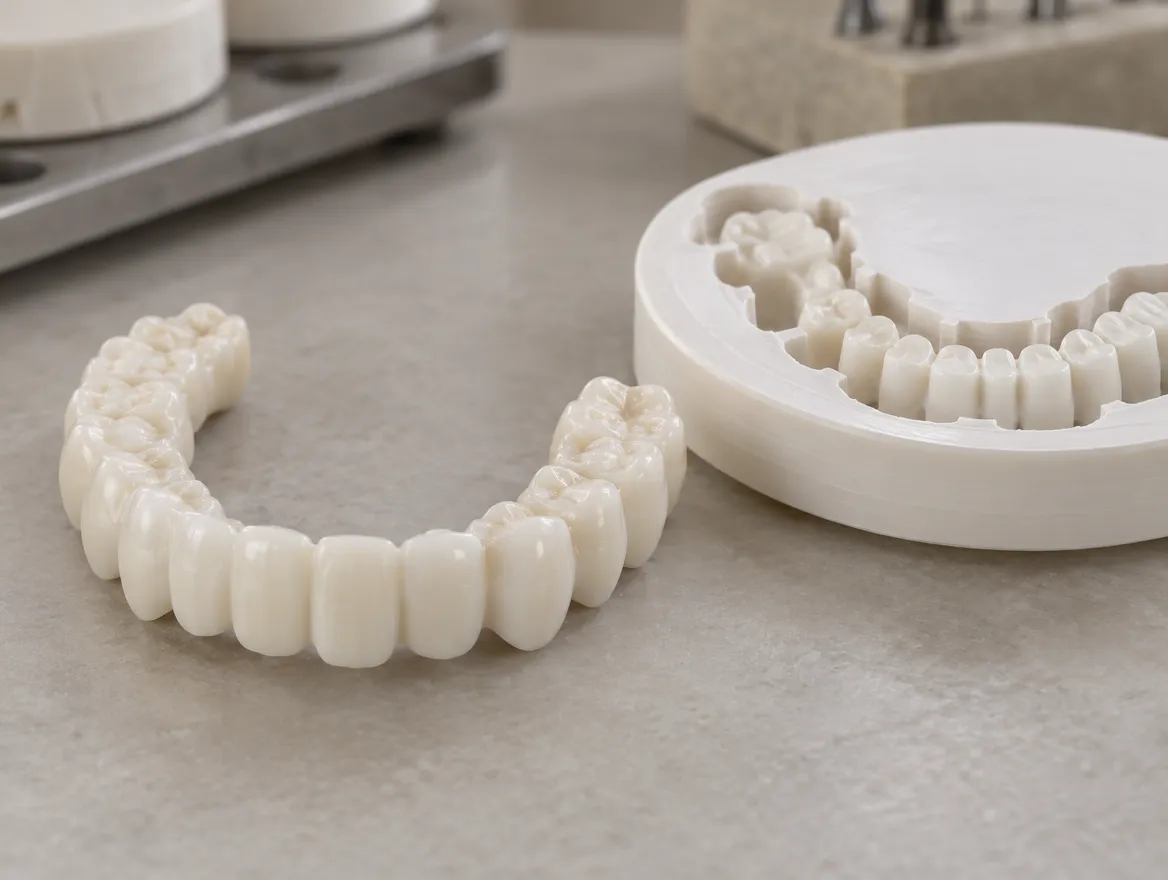
Zirconia is the strongest ceramic used in dentistry, which is why it has become the usual material for final full-arch teeth. It is not one material, though. Grades differ in strength and translucency, and the way a bridge is built from it changes how often it chips.
 Medically reviewed by Dt. Hüseyin Yavuz Özbek, implant surgeon · Updated October 2026
Dental zirconia is zirconium dioxide stabilised with yttria. The classic grade (3Y) is mostly tetragonal crystals and very tough; newer grades (4Y, 5Y) add cubic crystals for translucency at the cost of some toughness. In full-arch bridges, one-piece monolithic zirconia rarely breaks; most problems come from porcelain layered on top. A 2026 meta-analysis found technical complications of 1% to 3% with monolithic designs and up to 27% with veneered designs.
What zirconia is
Zirconia is zirconium dioxide, a white ceramic made of tiny crystals packed tightly together. Pure zirconia changes crystal shape as it cools, which makes it crack, so dental zirconia has yttrium oxide (yttria) added to hold the crystals in a stable form. The standard material is called Y-TZP: yttria-stabilised tetragonal zirconia polycrystal. A review in the Journal of Dental Research describes it as the strongest of the dental ceramics (Zhang et al., 2018).
Its toughness comes from a neat trick. When a crack starts to grow, the tetragonal crystals at its tip switch to a slightly larger crystal shape. That expansion squeezes the crack shut. Materials scientists call this transformation toughening; zirconia is studied as a "transforming ceramic" for exactly this reason (Turon-Vinas et al., 2018, in the sources).
3Y, 4Y and 5Y: the strength and translucency trade-off
Classic zirconia looks opaque and chalky. To make it more lifelike, manufacturers developed grades with more yttria, written as 3Y, 4Y and 5Y after their yttria content. Extra yttria brings in cubic crystals, which scatter less light, so the material becomes more translucent. Cubic crystals do not transformation-toughen, so strength and toughness fall.
Zhang and Lawn describe this as a concerted drive towards translucency while trying to keep adequate strength, and they list the limits of the main approaches: cutting the light-scattering alumina additive, or adding a cubic phase (Zhang et al., 2018).
| Grade | Crystal make-up | Appearance | Toughness | Typical full-arch use |
|---|---|---|---|---|
| 3Y | Mostly tetragonal | Most opaque | Highest | Back teeth, frameworks, high-load areas |
| 4Y | Tetragonal with some cubic | More translucent | Intermediate | A compromise for whole arches |
| 5Y | Substantial cubic content | Most translucent | Lowest | Front teeth where appearance leads |
| Multilayer discs | Grades blended through the disc | Graded from neck to edge | Varies through the piece | One-piece bridges with a natural colour gradient |
For a full-arch bridge, where long spans and heavy chewing forces are normal, the toughness end of the scale matters. Ask which grade is used where, especially at the connectors between teeth and over the implants.
Monolithic or layered: the design question that matters most
A zirconia bridge can be made in two broad ways. Monolithic bridges are milled as one solid piece of zirconia, then stained and glazed. Layered (veneered) bridges have a zirconia core with porcelain built up on the outside for colour and translucency. Some designs add pink porcelain only on the gum area.
The evidence on this point is unusually consistent:
- A 2017 systematic review of 285 one-piece zirconia full-arch bridges reported a failure rate of 1.4% (four fractures). Complications affected 16.1%, and 14.7% were minor chipping of veneered porcelain (Bidra et al., 2017).
- A study of 2,039 bridges from one laboratory, mainly monolithic with porcelain limited to the gum area, found a 5-year cumulative survival of 99.3% and no returns for chipping of the gum porcelain (Bidra et al., 2018).
- A 2026 meta-analysis of 13 studies and 2,841 monolithic bridges found 99% still in function at 12 to 62 months, with technical complications of 1% to 3% for monolithic designs and up to 27% for veneered designs (Matos et al., 2026).
- An umbrella review of reviews with five or more years of follow-up reported veneer chipping in 15% to 35% of veneered zirconia, and lower technical complication rates for monolithic zirconia (Tomar et al., 2026).
- Monolithic, in function
- 99% (12–62 months)
- Monolithic complications
- 1–3%
- Veneered complications
- up to 27%
- Evidence certainty
- Low (GRADE)
That last line matters. The 2026 meta-analysis rated the certainty of evidence as low, mainly because most studies were retrospective. The direction of the findings is clear; the exact numbers are not settled. The evidence library has the details of each study.
Where zirconia bridges still go wrong
Fractures that do happen tend to start at thin connectors between teeth, at the overhang behind the last implant, or where titanium sleeves bonded inside the bridge come loose. In the 2,039-bridge study, six bridges came back for debonded titanium cylinders and three for fractured cylinders (Bidra et al., 2018). Heavy grinding raises loads on every part of the system; a 2026 review of wear and complications linked bruxism without a protective night guard with more problems (Sanz et al., 2026).
A slower, chemical process is also studied. In moist conditions yttria-stabilised zirconia can gradually change crystal phase at its surface, called low-temperature degradation. A meta-analysis of laboratory studies found no significant overall change in surface roughness after artificial ageing, although the effect depended on how long specimens were aged (Yang et al., 2021, in the sources).
Zirconia and the rest of the bridge
Zirconia teeth sit on implants through screws and usually through multi-unit abutments. Some designs mill the bridge in zirconia alone; others place zirconia teeth on a titanium bar for added stiffness. Our frameworks and bars page explains why. For the temporary teeth fitted while implants heal, see acrylic and PMMA.
At Precious Dental, zirconia teeth and a titanium bar are both part of the full-arch package (£6,000 ≈ €7,170 · US$8,020 for four implants per jaw, both jaws in total). A full set of 24 zirconia teeth on natural teeth is £3,600. Your written plan should state the design; if it does not, ask.
Is it monolithic, or layered with porcelain, and where? Which zirconia grade is used for the back teeth and connectors? How long is the overhang behind the last implant? Will I get a night guard if I grind? What does the guarantee cover if the bridge chips or breaks?
Common questions
Is zirconia the same as porcelain?
No. Both are ceramics, but zirconia is a polycrystalline oxide ceramic that is far tougher than the glassy porcelains traditionally layered on metal. Porcelain is sometimes layered over zirconia for appearance, and that layer is where most chipping happens.
Can a zirconia bridge break?
It can, but it is uncommon. A laboratory study of 2,039 mainly monolithic full-arch zirconia bridges reported a 5-year cumulative survival of 99.3%, with six fractures. Thin connectors, long overhangs behind the last implant and heavy grinding raise the risk.
Will zirconia wear my natural teeth in the other jaw?
Clinical data on this are still thin. A 2026 systematic review of wear in fixed implant bridges found only one study that measured wear of the opposing teeth, and it found no significant difference between restorative materials and natural enamel. Keeping the zirconia surface well polished after any adjustment is standard advice.
Does zirconia age in the mouth?
Yttria-stabilised zirconia can slowly change crystal phase in moist conditions, a process called low-temperature degradation. A meta-analysis of laboratory studies found no significant overall change in surface roughness after artificial ageing, though results depended on test duration.
What kind of zirconia does Precious Dental use?
Zirconia teeth are included in Precious Dental's full-arch packages. Ask us which zirconia grade and design (fully monolithic or with layered porcelain) is planned for your bridge; it should be stated in your written plan.
Sources
- Zhang Y, Lawn BR. Novel Zirconia Materials in Dentistry. J Dent Res 2018. PMID 29035694
- Turon-Vinas M, et al. Strength and fracture toughness of zirconia dental ceramics. Dent Mater 2018. PMID 29395472
- Bidra AS, et al. Clinical outcomes of full arch fixed implant-supported zirconia prostheses: A systematic review. Eur J Oral Implantol 2017. PMID 28944367
- Bidra AS, et al. Survival of 2039 complete arch fixed implant-supported zirconia prostheses: A retrospective study. J Prosthet Dent 2018. PMID 28689903
- Matos ACM, et al. Are monolithic zirconia complete arch implant-supported prostheses reliable? A systematic review and meta-analysis. J Prosthet Dent 2026. PMID 41813561
- Tomar S, et al. Prosthetic complications of implant-supported complete arch prostheses: An umbrella review of systematic reviews. J Prosthet Dent 2026. PMID 41927400
- Sanz E, et al. Prosthesis wear and complications in various materials used for fixed implant-supported prostheses: A systematic review. J Prosthet Dent 2026. PMID 41991355
- Yang H, et al. Effects of low-temperature degradation on the surface roughness of yttria-stabilized tetragonal zirconia polycrystal ceramics: A systematic review and meta-analysis. J Prosthet Dent 2021. PMID 32115216
Checked October 2026. Where we give our own view as a clinic, we say so.
Get your own full-mouth plan and price in writing
Send a recent panoramic X-ray or CBCT scan, or a few clear photos. Our implant surgeon reviews them and you receive an itemised plan in pounds, with approximate euro and dollar figures, before you book anything.