Materials science: what a full-arch implant bridge is made of
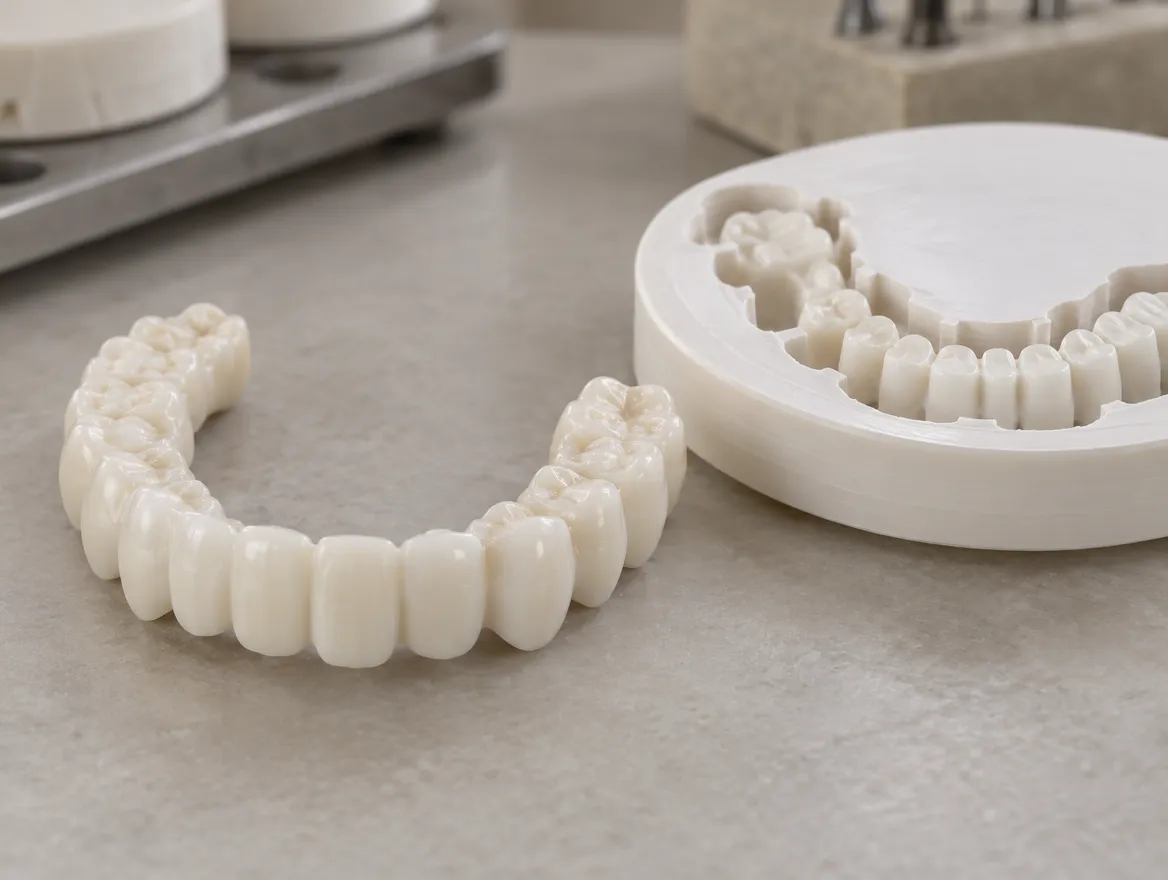
A fixed full-arch bridge is a small piece of engineering: titanium in the bone, connectors and screws above it, a framework, and teeth made of ceramic or polymer. Each material was chosen for a reason, and each has a known way of wearing or failing.
Four layers, four materials
Think of a full-arch bridge from the bone upwards.
- Implants, almost always titanium or a titanium alloy, sit in the bone and bond to it.
- Abutments and screws, usually titanium, connect the implants to the bridge. Full arches often use multi-unit abutments.
- A framework gives the bridge stiffness: a milled titanium bar, a cobalt-chromium casting, a high-performance polymer, or the zirconia itself.
- Teeth and gum, made of zirconia, porcelain, acrylic (PMMA) or composite.
Temporary teeth fitted on the day of surgery are usually different from the final teeth, because they have a different job: they must be quick to make, easy to adjust and rigid enough to protect healing implants.
The materials explainers
Acrylic and PMMA
PMMA, composite and printed resins: why temporaries are plastic, and how they wear and stain.
Open →Frameworks and bars
Titanium bars, CoCr and PEEK frameworks, multi-unit abutments, passive fit and screws.
Open →Titanium
Pure grades and alloys, surface treatments, the oxide layer and titanium allergy.
Open →Zirconia
Crystal phases, 3Y to 5Y grades, monolithic vs layered bridges, and chipping data.
Open →How each layer tends to fail
No material is perfect, and the honest question is not "which never breaks" but "how does it fail, how often, and how easy is it to fix". An umbrella review of seven systematic reviews with at least five years of follow-up summarised the pattern for full-arch bridges: prosthesis survival between 89.5% and 96.8%, screw loosening in 5% to 15%, chipping in 15% to 35% of veneered zirconia, and framework fractures in under 5% (Tomar et al., 2026).
| Layer | Usual material | Typical problem | Usually fixable? |
|---|---|---|---|
| Implant | Titanium or titanium-zirconium | Failure to integrate, or bone loss years later | Sometimes; may need a new implant |
| Screws and abutments | Titanium alloy | Loosening | Yes, usually at a routine visit |
| Framework | Titanium, CoCr, PEEK or zirconia | Rare fracture; debonding of teeth from polymer frameworks | Often needs laboratory work |
| Teeth | Zirconia, porcelain, PMMA, composite | Chipping (porcelain), wear and staining (acrylic) | Usually, by repair or remake of the teeth |
Precious Dental places MegaGen, Neodent or Straumann implants at the same price (£300 per implant), and its full-arch packages include zirconia teeth, a titanium bar and temporary teeth. Brand names are used for information only; we are not affiliated with any implant maker. Your written plan states the implant brand and the materials for your bridge.
Unfamiliar terms are in the glossary; the studies behind each figure are in the evidence library; complication figures across treatments are on the complication rates page.
Get your own full-mouth plan and price in writing
Send a recent panoramic X-ray or CBCT scan, or a few clear photos. Our implant surgeon reviews them and you receive an itemised plan in pounds, with approximate euro and dollar figures, before you book anything.