Full-mouth treatment types: a reference guide
A single page that sets out every family of full-mouth treatment in the same terms: what it is made of, how many implants it uses, how much bone it needs, how it is looked after, and what the published evidence says about it.
 Medically reviewed by Dt. Hüseyin Yavuz Özbek, implant surgeon · Updated October 2026
Full-mouth treatment falls into five families: a fixed bridge on four to six implants per jaw, more implants carrying a bridge in two or three sections, anchorage in the cheekbone (zygomatic) or behind the upper jaw (pterygoid) when bone is very thin, a removable overdenture that clips onto two to four implants, and crowns or bridges on your own healthy teeth. Fixed options stay in; overdentures come out for cleaning.
How to read this guide
Clinics describe the same treatment in many ways: brand names, package names, "teeth in a day", "permanent teeth". This page strips those labels off and sorts treatment by how it is built. Each section answers the same questions in the same order, so you can compare like with like. The options explorer applies these families to your own answers.
The five families at a glance
| Family | Fixed or removable | Implants per jaw | Bone needed | Visits to Antalya | Upkeep |
|---|---|---|---|---|---|
| Fixed full arch | Fixed | 4 to 6 | Moderate, mainly at the front | Usually 2 | Cleaning under the bridge; professional check-ups |
| Segmented bridges | Fixed | Usually 8 or more | Good along the whole jaw | Usually 2 | As above; sections can be repaired separately |
| Zygomatic or pterygoid | Fixed | Combinations, e.g. 2 zygomatic plus 2 front | Little in the upper jaw | Confirmed case by case | As above; watch for sinus symptoms |
| Implant overdenture | Removable | 2 to 4 | Least | Usually 2 | Take out daily; clip replacements over time |
| Crowns on own teeth | Fixed | None, or a few single implants | Healthy teeth needed | Often 1 | Normal brushing and flossing |
Fixed full arch on four to six implants
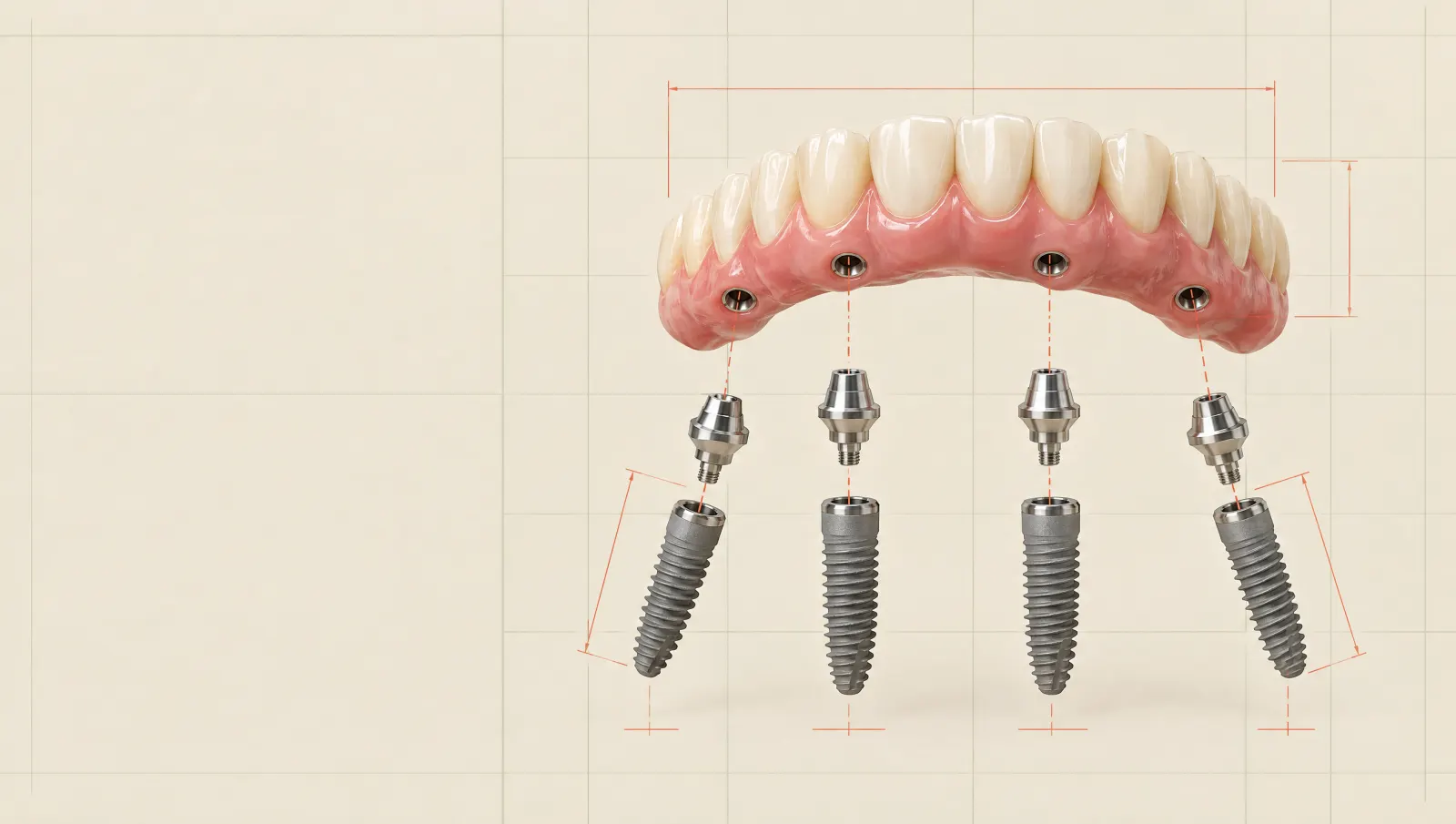
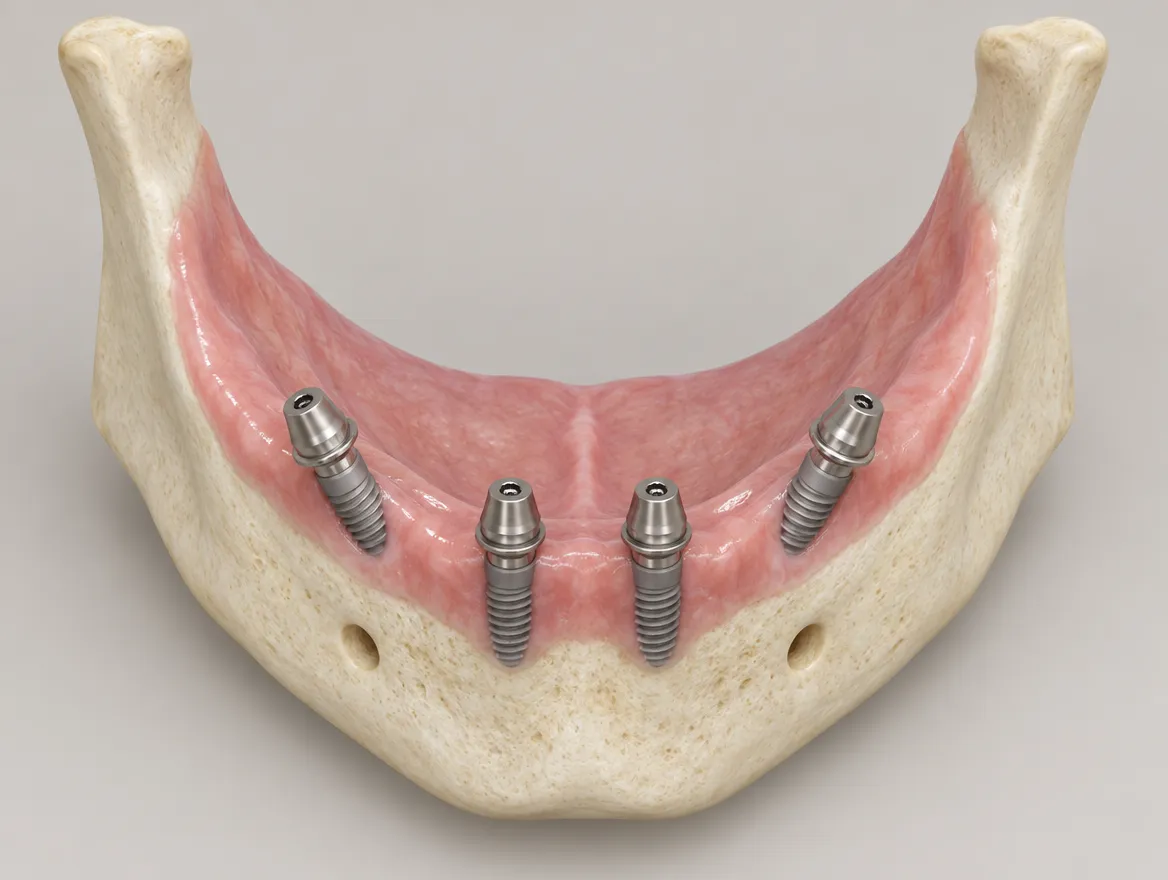
What it is. One rigid bridge carrying a full set of teeth, usually 10 to 14 per jaw, screwed onto four to six implants. The patient cannot remove it; the dentist can, by undoing the screws. In four-implant designs the two back implants are tilted so they avoid the sinus in the upper jaw or the nerve in the lower jaw while still reaching good bone. See the lower jaw and nerve.
What it is made of. Titanium implants, angled multi-unit abutments, and a bridge that is often zirconia, sometimes over a milled titanium bar, or acrylic teeth on a metal framework. The temporary bridge fitted after surgery is usually acrylic (PMMA). The materials section explains each.
Evidence. For the lower jaw, a systematic review of 17 prospective studies reported implant survival of 98.42% at five years and 96.86% at ten for rough-surface implants, and bridge survival of 97.25% at ten years; the number of implants did not change implant survival Papaspyridakos et al., 2014. The developers of the four-implant concept reported 94.8% implant success with up to ten years of follow-up in 245 lower jaws Maló et al., 2011. Fixed teeth can be fitted straight after surgery when the implants are firm enough: a review of loading protocols found similar survival with immediate, early and conventional loading in selected cases Papaspyridakos et al., 2014.
Upkeep. Cleaning under the bridge with floss threaders, interdental brushes or a water flosser, and professional check-ups. The bridge may be unscrewed at some visits for cleaning.
More implants and segmented bridges
What it is. Instead of one bridge on a few implants, eight or more implants carry a bridge in two, three or four sections. It resembles natural teeth more closely: if one section has a problem, the others stay in place.
Bone needed. Good bone along the whole jaw, including the back. That is often missing in people who have lost teeth years earlier, because the jaw shrinks after extractions (see bone-loss stages). It also means more surgery and more parts, and so usually a higher cost.
When it is chosen. Mostly for people with failing teeth but plenty of bone, or where a surgeon prefers independent sections for repair. It is a design choice rather than a separate technique, and studies of fixed full-arch bridges usually include both one-piece and segmented designs.
Zygomatic and pterygoid anchorage
What it is. When the upper jaw has lost so much bone that standard implants have nothing to hold, long implants can be anchored in the cheekbone (zygomatic implants) or far back in the pterygoid region behind the upper jaw. They are joined to a fixed bridge, usually together with standard implants at the front. The cheekbone anchorage explainer shows the path these implants take.
Evidence. An updated systematic review of 4,556 zygomatic implants in 2,161 patients reported a 12-year cumulative survival rate of 95.21%, with most failures in the first six months; sinusitis was the most common complication at 2.4% Chrcanovic et al., 2016. For pterygoid implants, a 2024 review reported a 10-year cumulative survival of 92.5% Raouf, 2024.
Why it matters. It can avoid bone grafting and the months of healing a graft needs. It is also more complex surgery, done by surgeons with specific training. Precious Dental's zygomatic implant price is £2,000 per implant; see prices.
Implant overdentures
What it is. A denture that clips onto two to four implants using ball, locator or bar attachments. It comes out for cleaning and at night. Because it is held by implants, it does not slide around like a conventional denture.
Evidence. For the lower jaw, the 2002 McGill consensus statement concluded that a two-implant overdenture should be the first choice of treatment for people with no lower teeth Feine et al., 2002. Upper overdentures usually need more implants than lower ones.
Trade-offs. The least surgery, the least bone needed and the lowest cost of the implant options. Attachments wear and need replacing from time to time. For people who would find it hard to clean under a fixed bridge, being able to take the teeth out can be an advantage.
Tooth-supported full-mouth crowns
What it is. Crowns or bridges on your own teeth, often combined with a few single implants where teeth are missing. This is a full-mouth restoration rather than full-mouth implants, and it depends on having enough healthy teeth with healthy roots and gums. Precious Dental's price for a set of 24 zirconia teeth is £3,600.
When it is chosen. When teeth are worn, broken or discoloured but still sound underneath. A dentist will usually try to keep healthy teeth before replacing them; implants are not a reason to remove teeth that can be saved.
Maintenance applies to every family
Whatever the design, implants need cleaning at home and professional care. A systematic review of maintenance linked regular professional care with fewer biological complications and suggested recall at least every 5 to 6 months, tailored to risk Monje et al., 2016. The complication-rate data shows what tends to go wrong, and how often, for each design.
Terms you will meet in a quote
- Arch
- One jaw, upper or lower
- Fixed / screw-retained
- Stays in; removed only by the dentist
- Overdenture
- Clips onto implants; you take it out
- Immediate loading
- Teeth fitted within a week of surgery
- Zygomatic
- Implant anchored in the cheekbone
Every term is defined in the glossary, and the studies behind the figures on this page are summarised in the evidence library.
Common questions
What is the difference between full-mouth and full-arch?
A full arch is one jaw, upper or lower. Full-mouth usually means both jaws, though some clinics use it for one jaw. Always check whether a quote covers one arch or two. Precious Dental's All-on-4 and All-on-6 package prices are for both jaws together.
Is All-on-4 the same as a fixed full arch?
All-on-4 is Nobel Biocare's trademark for one well-known way of carrying a fixed full-arch bridge on four implants, with the back two tilted. Other makers and clinics use the same principle under other names. We describe it generically as a fixed full arch on four implants.
Why do some plans use six or more implants per jaw?
More implants spread the load and leave a back-up if one fails. They also need more bone along the jaw. Four-implant designs tilt the back implants to make use of the bone at the front. Which is better for you depends on your scan.
Can fixed and removable options be mixed?
Yes. It is common to have a fixed bridge in one jaw and an overdenture or natural teeth in the other. Each jaw is planned on its own bone and needs.
Which option lasts longest?
Published survival figures for implants and fixed bridges are high for all the implant-based options, but each study measures different things over different periods. See the survival-rate data page for the numbers side by side.
Sources
- Papaspyridakos P, Mokti M, Chen CJ, et al. Implant and prosthodontic survival rates with implant fixed complete dental prostheses in the edentulous mandible after at least 5 years: a systematic review. Clin Implant Dent Relat Res 2014. PMID 23311617
- Malo P, de Araújo Nobre M, Lopes A, et al. A longitudinal study of the survival of All-on-4 implants in the mandible with up to 10 years of follow-up. J Am Dent Assoc 2011. PMID 21357865
- Papaspyridakos P, Chen CJ, Chuang SK, Weber HP. Implant loading protocols for edentulous patients with fixed prostheses: a systematic review and meta-analysis. Int J Oral Maxillofac Implants 2014. PMID 24660202
- Chrcanovic BR, Albrektsson T, Wennerberg A. Survival and Complications of Zygomatic Implants: An Updated Systematic Review. J Oral Maxillofac Surg 2016. PMID 27422530
- Raouf K, Chrcanovic BR. Clinical Outcomes of Pterygoid and Maxillary Tuberosity Implants: A Systematic Review. J Clin Med 2024. PMID 39124809
- Feine JS, Carlsson GE, Awad MA, et al. The McGill consensus statement on overdentures. Mandibular two-implant overdentures as first choice standard of care for edentulous patients. Gerodontology 2002. PMID 12164236
- Monje A, Aranda L, Diaz KT, et al. Impact of Maintenance Therapy for the Prevention of Peri-implant Diseases: A Systematic Review and Meta-analysis. J Dent Res 2016. PMID 26701350
Checked October 2026. Where we give our own view as a clinic, we say so.
Get your own full-mouth plan and price in writing
Send a recent panoramic X-ray or CBCT scan, or a few clear photos. Our implant surgeon reviews them and you receive an itemised plan in pounds, with approximate euro and dollar figures, before you book anything.