Frameworks, bars and screws: the engineering inside a full-arch bridge
Under the teeth of most fixed full-arch bridges is a framework that keeps the whole arch stiff and links it to the implants. It is hidden, but it decides a lot: how forces reach the bone, how often screws loosen and how easily the bridge can be repaired.
 Medically reviewed by Dt. Hüseyin Yavuz Özbek, implant surgeon · Updated October 2026
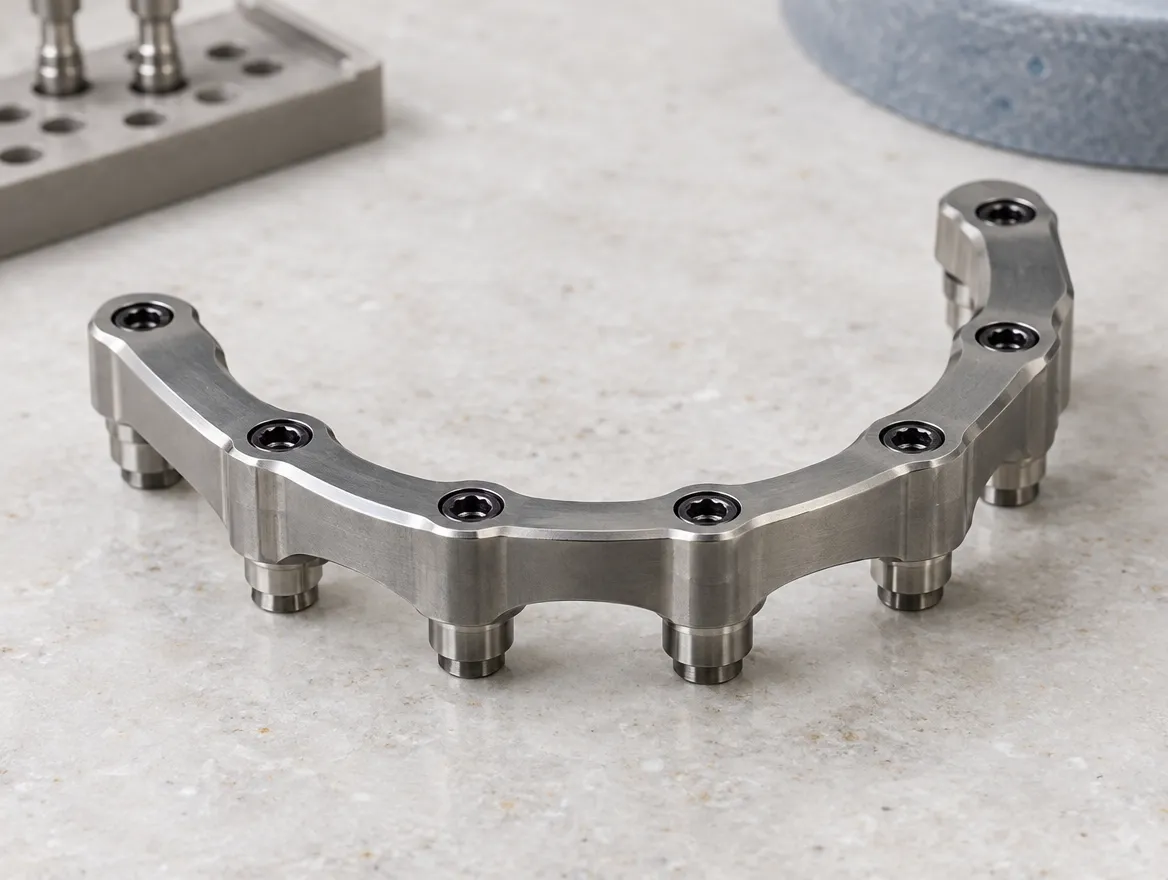
A full-arch framework is the rigid skeleton of an implant bridge. It is usually a milled titanium bar, sometimes cobalt-chromium, a high-performance polymer such as PEEK, or zirconia itself. It connects to the implants through screws, often via multi-unit abutments that correct implant angles. Frameworks are made to fit without strain (passive fit) by computer milling. Screw loosening is the commonest mechanical problem, reported in 5% to 15% of full-arch bridges over five or more years.
What a framework does
A fixed full-arch bridge spans the whole jaw on four to six implants. Chewing forces land wherever food happens to be, often on a tooth with no implant beneath it. The framework spreads that force across all the implants, keeps the long horseshoe shape from flexing, and gives the teeth something solid to be fixed to.
Stiffness matters most at the ends. Teeth behind the last implant hang out on a cantilever, which acts like a lever on the nearest implant and on the framework itself. Tilting the back implants, as described on the lower-jaw page, is one way of shortening that lever without extra surgery (Lin et al., 2018).
Framework materials compared
| Framework | How it is made | Good at | Watch for |
|---|---|---|---|
| Milled titanium bar | Cut from a solid titanium block from a digital design | Stiff, light, accurate fit, compatible with implant parts | Teeth bonded or processed onto it can wear or debond |
| Cobalt-chromium | Cast, milled or laser-sintered alloy | Very stiff, often cheaper than titanium | Heavier; casting can distort if not milled |
| PEEK / PEKK | Milled high-performance polymer | Light, slightly shock-absorbing, metal-free | Short-term data only; debonding of veneers most common problem |
| Zirconia (no separate bar) | Whole bridge milled in zirconia, bonded to titanium sleeves | Strong, hygienic, few chips if monolithic | Sleeves can debond; thin connectors are the weak point |
The polymer option has the least evidence. A systematic review of 119 full-arch bridges on PEEK or PEKK frameworks reported 97.3% cumulative survival for PEEK at short follow-up and found adhesion problems to be the commonest complication (Mishra et al., 2023). For one-piece zirconia, a 2,039-bridge laboratory series recorded six returns for debonded titanium cylinders and three for fractured cylinders over five years (Bidra et al., 2018). Metal frameworks with acrylic teeth showed more wear-related complications in a 2026 review (Sanz et al., 2026).
Multi-unit abutments: lining everything up
Implants in a full arch rarely point the same way. The back ones may be tilted, the front ones upright, and the gum may be thick in one place and thin in another. A multi-unit abutment is a short titanium connector screwed onto each implant that brings the connection up to gum level and, in angled versions, straightens the screw path. The bridge then screws onto the abutments.
That arrangement has practical benefits. The connection between abutment and implant is left undisturbed when the bridge is removed for cleaning or repair, and all the screw holes in the bridge can come out on the chewing or tongue side of the teeth, where they can be filled and hidden.
Passive fit: why the framework must not strain the implants
Natural teeth move slightly in their sockets; implants do not. If a framework is even fractionally out of line and the screws pull it into place, the strain stays locked into the screws, the framework and the bone. Engineers call the goal passive fit: the framework should seat on all implants at once without being forced.
Modern frameworks are designed on a digital model and milled from solid blocks, which avoids the shrinkage and distortion that casting can introduce. Clinics check fit with X-rays, a one-screw test or by trying in a verification jig before the final bridge is made.
The clinical evidence is thinner than the engineering logic. A 2026 systematic review found only six studies on misfit in multi-unit implant bridges; most found no consistent link between misfit and clinical outcomes, while one found more screw complications with greater misfit (He et al., 2026). Dentists still treat passive fit as a basic quality standard, mainly to protect screws.
Screws: small parts, common repairs
A prosthetic screw holds by being stretched very slightly when it is tightened to a specified torque. That stretch, called preload, clamps the parts together. Chewing cycles, grinding and any misfit can gradually reduce it until the screw works loose.
Two findings are useful here. An umbrella review of full-arch bridges followed for five to fifteen years reported screw loosening in 5% to 15% of cases, and linked screw-retained designs with fewer technical problems overall (Tomar et al., 2026). A meta-analysis of laboratory studies found that repeatedly tightening and loosening the same screw reduced the torque needed to remove it after five cycles, with visible wear and deformation after ten (Shui et al., 2026). That is why many dentists fit new screws when a bridge is finally seated, rather than reusing the ones that held it during try-ins.
- Screw loosening
- 5–15% (5+ years)
- Framework fracture
- under 5%
- Prosthesis survival
- 89.5–96.8%
- Screw reuse
- Grip falls after ~5 cycles (lab)
Frameworks at Precious Dental
Precious Dental's full-arch packages (£6,000 ≈ €7,170 · US$8,020 on four implants per jaw, £6,500 ≈ €7,760 · US$8,690 on six, both jaws in total) include zirconia teeth and a titanium bar; a titanium bar on its own is listed at £275 ≈ €328 · US$368. The 3D scan and the planned position of each implant decide the framework design. Ask us whether multi-unit abutments are planned, how the bridge will be fixed, and how it can be removed for cleaning or repair at check-ups. More figures on long-term problems are on the complication rates page, and the zirconia page covers the teeth that sit on the bar.
What is my framework made of, and is it milled? Will there be multi-unit abutments? How long is the overhang behind the last implant? How is fit checked before the final bridge is made? Are new screws used at final fitting, and can a dentist at home remove the bridge for cleaning?
Common questions
Do I need a titanium bar in my bridge?
Not always. Some bridges are milled in one piece of zirconia without a separate bar; others put teeth on a titanium bar for added stiffness and easier repair. The choice depends on the design, the space available and the opposing bite. At Precious Dental a titanium bar is included in the full-arch packages and is listed separately at £275 per bar.
What is a multi-unit abutment?
A small titanium connector screwed onto each implant. It lifts the connection to gum level and, in angled versions, corrects the direction of tilted implants so all the screw holes in the bridge line up. The bridge is then screwed to the abutments rather than directly to the implants.
Why do bridge screws come loose?
Screws hold by stretching slightly when tightened. Repeated chewing, grinding, a framework that does not fit perfectly and reusing old screws can all reduce that grip. Loosening is usually fixed at a routine visit by retightening or replacing the screw.
Is a metal framework a problem for MRI or airports?
Titanium is not magnetic. Tell the radiographer about any dental metal before an MRI, because it can cause image distortion near the jaw. Dental frameworks are not normally an issue at airport security.
Can a framework break?
It is uncommon. An umbrella review reported framework fractures in under 5% of full-arch bridges over five to fifteen years. Long overhangs behind the last implant and heavy grinding raise the risk.
Sources
- Tomar S, et al. Prosthetic complications of implant-supported complete arch prostheses: An umbrella review of systematic reviews. J Prosthet Dent 2026. PMID 41927400
- He Z, et al. Clinical implications of misfit in multiunit implant-supported fixed dental prostheses: A systematic review. J Prosthodont 2026. PMID 42693826
- Shui Y, et al. Impact of repeated tightening and loosening on the implant-prosthetic screw joint: A systematic review and meta-analysis. J Dent 2026. PMID 41203042
- Mishra SK, et al. Complete-arch implant-supported fixed dental prostheses fabricated with PEEK and PEKK framework: a systematic review. Evid Based Dent 2023. PMID 37674039
- Sanz E, et al. Prosthesis wear and complications in various materials used for fixed implant-supported prostheses: A systematic review. J Prosthet Dent 2026. PMID 41991355
- Bidra AS, et al. Survival of 2039 complete arch fixed implant-supported zirconia prostheses: A retrospective study. J Prosthet Dent 2018. PMID 28689903
- Lin WS, Eckert SE. Clinical performance of intentionally tilted implants versus axially positioned implants: A systematic review. Clin Oral Implants Res 2018. PMID 30328193
Checked October 2026. Where we give our own view as a clinic, we say so.
Get your own full-mouth plan and price in writing
Send a recent panoramic X-ray or CBCT scan, or a few clear photos. Our implant surgeon reviews them and you receive an itemised plan in pounds, with approximate euro and dollar figures, before you book anything.