Titanium: why almost every implant is made of it
Titanium has been the default implant metal since the 1960s. The reasons are a self-healing oxide skin, a good balance of strength and lightness, and bone's willingness to grow right up against it. The details, from grade to surface finish, explain why implant data sheets read the way they do.
 Medically reviewed by Dt. Hüseyin Yavuz Özbek, implant surgeon · Updated October 2026
Dental implants are made of commercially pure titanium (usually grade 4) or titanium alloys such as titanium-aluminium-vanadium or titanium-zirconium. Titanium forms a thin, stable oxide layer that resists corrosion and allows bone to bond to it. Modern implants are roughened at microscopic scale because bone responds more strongly to moderately rough surfaces. True titanium allergy is rare; a 2026 review found only 20 diagnosed cases in the published clinical literature.
Why titanium works in bone
Bare titanium reacts with oxygen within moments and forms a thin layer of titanium dioxide on its surface. That oxide skin is chemically stable, protects the metal underneath from corrosion and re-forms if it is scratched. A systematic review on titanium hypersensitivity sums up the material's appeal the same way: a passivating oxide layer for corrosion resistance, plus high strength and low weight (Singh et al., 2021, in the sources).
Bone also tolerates titanium unusually well. Brånemark's group showed that bone could grow into direct contact with titanium and carry fixed teeth for years, the process now called osseointegration. Our osseointegration page explains how that bond forms week by week.
Grades and alloys
"Titanium" on an implant card can mean several different materials. Commercially pure titanium comes in grades 1 to 4, and grade 4 is the strongest of the pure grades. Alloys add other elements for strength.
| Material | What it is | Where you meet it | Trade-off |
|---|---|---|---|
| Commercially pure, grade 4 | Unalloyed titanium with small amounts of oxygen and iron | Many implant bodies | Long track record in bone; lower strength than alloys |
| Ti-6Al-4V (grade 5) | Titanium with about 6% aluminium and 4% vanadium | Some implants, many abutments, screws and milled bars | Stronger than the pure grades, so useful for thin parts under high load |
| Titanium-zirconium | Titanium alloyed with zirconium (Straumann's version is called Roxolid) | Mainly narrow implants | Higher tensile strength than pure titanium; shorter clinical record |
The titanium-zirconium option exists because narrow implants made of pure titanium carry a higher risk of fracture. A systematic review of nine studies (607 patients, 922 narrow titanium-zirconium implants) reported survival of 97.7% and success of 97.3% at two years, with mean bone loss around the implants of 0.41 mm, and noted the alloy's higher tensile strength than commercially pure titanium (Altuna et al., 2016). Follow-up was short, so long-term figures still come from conventional titanium.
The surface: where bone actually attaches
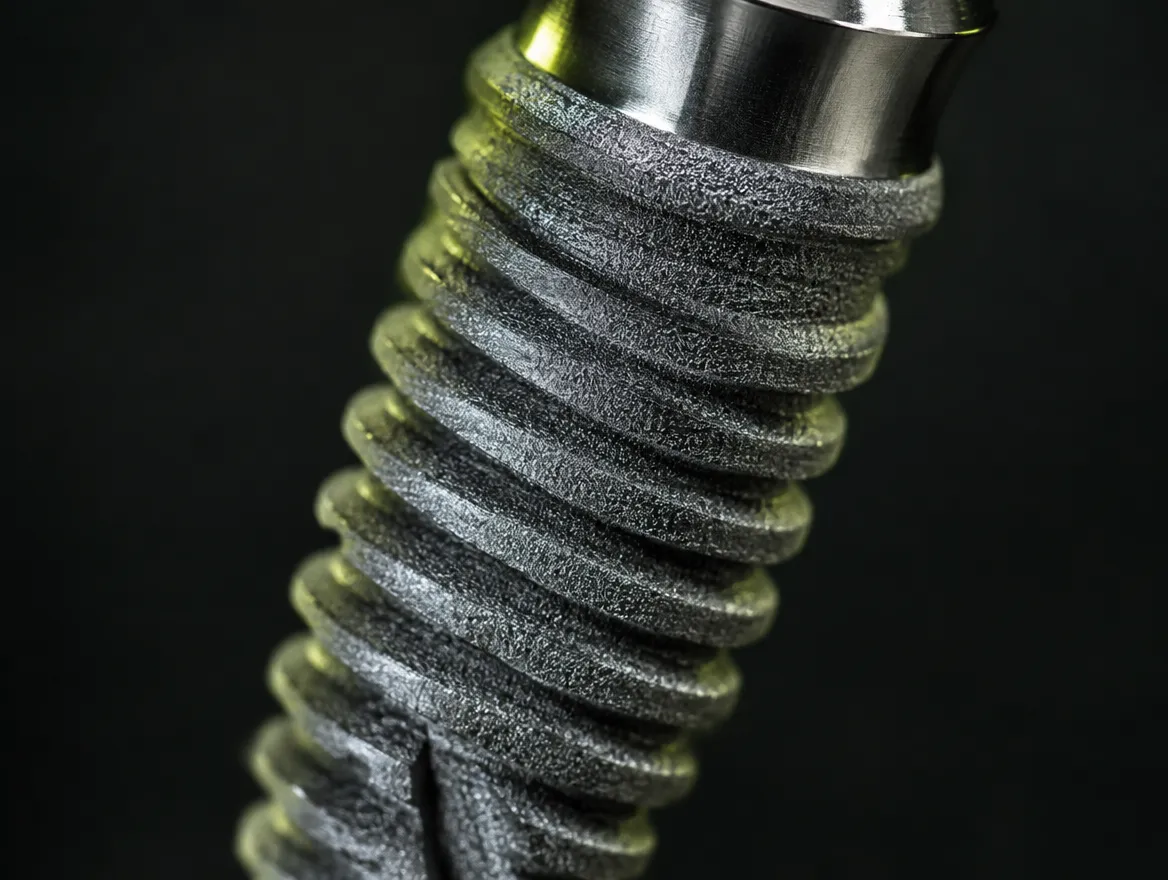
Early implants were machined smooth. Most modern implants are roughened, because bone responds more strongly to a textured surface. Roughness is described by Sa, the average height variation across a surface, in micrometres (thousandths of a millimetre).
A systematic review by Wennerberg and Albrektsson found that smooth surfaces (Sa below 0.5 µm) and minimally rough surfaces (0.5 to 1 µm) produced weaker bone responses than rougher surfaces, and that moderately rough surfaces (1 to 2 µm) did better than rough surfaces (above 2 µm) in some studies (Wennerberg et al., 2009). The same review criticised many papers for describing surfaces poorly, which is why brochure claims about a "unique surface" deserve caution.
- Smooth
- Sa < 0.5 µm
- Minimally rough
- 0.5–1 µm
- Moderately rough
- 1–2 µm
- Rough
- > 2 µm
Common ways of making that texture include sandblasting followed by acid-etching, and electrochemical oxidation (anodising), which thickens the oxide layer and gives it a porous structure. Different brands use different methods, and the surface is one of the main things that separates a premium system from a basic one. In the animal study described on our osseointegration page, new bone formed directly on a sandblasted, acid-etched surface within the first week (Berglundh et al., 2003).
There is a counterweight. A rough surface that becomes exposed to the mouth, because bone has been lost around the top of an implant, collects bacteria more easily than a smooth one. That is part of why peri-implantitis is taken seriously and why check-ups matter. The data are on our complication rates page.
Titanium allergy: rare, real, hard to test
Some readers worry that they might react to titanium. The best current answer is that true hypersensitivity is rare but does exist. A 2026 systematic review screened 1,761 records and found only nine eligible studies: one prospective study and eight case reports, involving 21 patients and 33 implants. Twenty implants were diagnosed as hypersensitivity cases; 17 were removed and three were managed by changing the abutment (Restelli et al., 2026).
The authors also point out that diagnosis is not standardised: skin patch tests, blood tests and tissue analysis were all used. If you have a history of metal allergy, tell your dentist early. Zirconia (ceramic) implants exist for people who want to avoid metal; the evidence for them in full arches is thinner, as our zirconia page explains.
Titanium above the bone: abutments, screws and bars
The implant body is not the only titanium in a full-arch bridge. Abutments, which connect the implant to the teeth, and the screws that hold everything together are usually made of titanium alloy, because they are thin parts that carry concentrated loads. Many full-arch bridges also contain a milled titanium bar that keeps the whole arch stiff. Our frameworks and bars page explains those parts and why screws occasionally loosen.
Gum tissue attaches around the abutment, not the implant body, so the abutment surface is usually smooth or only lightly textured. A smooth surface collects less plaque where it passes through the gum, which helps keep the seal around the implant healthy. It is one more place where the design of a titanium part is a deliberate compromise between grip and cleanability.
Brands at Precious Dental
Precious Dental places MegaGen, Neodent or Straumann implants, all at the same price of £300 ≈ €358 · US$401 per implant. These are large manufacturers with published technical documentation on their materials and surfaces; check the brand's own literature if you want the exact alloy and surface treatment. Brand names here are nominative only, and we are not affiliated with any implant maker.
Whichever brand is used, you should leave with a record of it. Precious Dental gives every implant patient an implant passport and copies of their X-rays and scans, so a dentist anywhere in the world can identify the parts later. That matters more than many people realise: compatible spare parts are brand-specific.
Which brand and model will you use, and is it pure titanium or an alloy? What surface treatment does it have? Will I receive the implant details in writing? Are parts for this system available in my home country?
Common questions
Is grade 4 or grade 5 titanium better for implants?
Neither is better in every way. Commercially pure titanium (grade 4) has a long clinical record in bone. Alloys such as grade 5 (titanium with aluminium and vanadium) and titanium-zirconium are stronger, which matters most for narrow implants and for screws and abutments. The implant brand's documentation states which is used.
Can I be allergic to titanium implants?
It is possible but rare. A 2026 systematic review found nine studies, mostly case reports, describing 20 implants diagnosed as titanium hypersensitivity cases. If you have reacted to metals before, tell your dentist; there is no single reliable test yet.
Do titanium implants set off airport scanners or affect MRI?
Dental implants are small and are not normally a problem at airport security. For MRI, tell the radiographer you have implants; titanium is not magnetic, but metal can cause image artefacts near the jaw.
Which implant brands does Precious Dental use?
MegaGen, Neodent or Straumann, all at £300 per implant. Your written plan names the brand chosen for you, and your implant passport records the exact implants placed. We are not affiliated with any implant maker.
Will my implant corrode or rust?
Titanium's oxide layer makes it highly corrosion-resistant in the mouth. Very small particles can be released by wear or during cleaning of a diseased implant, and researchers are still studying their role in inflammation, so regular check-ups remain important.
Sources
- Wennerberg A, Albrektsson T. Effects of titanium surface topography on bone integration: a systematic review. Clin Oral Implants Res 2009. PMID 19663964
- Altuna P, Lucas-Taulé E, Gargallo-Albiol J, Figueras-Álvarez O, Hernández-Alfaro F, Nart J. Clinical evidence on titanium-zirconium dental implants: a systematic review and meta-analysis. Int J Oral Maxillofac Surg 2016. PMID 26852292
- Restelli L, et al. Titanium hypersensitivity in dental implants: A systematic review of updated clinical evidence and diagnostic strategies. J Prosthodont Res 2026. PMID 41581901
- Singh R, et al. Prevalence of Titanium Hypersensitivity in Patients with Titanium Implants: A Systematic Review and Meta-analysis. J Pharm Bioallied Sci 2021. PMID 35017986
- Brånemark PI, et al. Osseointegrated implants in the treatment of the edentulous jaw. Experience from a 10-year period. Scand J Plast Reconstr Surg Suppl 1977. PMID 356184
- Berglundh T, Abrahamsson I, Lang NP, Lindhe J. De novo alveolar bone formation adjacent to endosseous implants. Clin Oral Implants Res 2003. PMID 12755774
Checked October 2026. Where we give our own view as a clinic, we say so.
Get your own full-mouth plan and price in writing
Send a recent panoramic X-ray or CBCT scan, or a few clear photos. Our implant surgeon reviews them and you receive an itemised plan in pounds, with approximate euro and dollar figures, before you book anything.