Acrylic, PMMA and printed resins: the polymers in full-arch teeth
Almost everyone who has fixed teeth fitted on implants starts with polymer teeth. They are made quickly, they absorb some of the shock of biting while the implants heal, and they are easy to adjust. They also wear and stain, which is why most people later move to a harder final material.
 Medically reviewed by Dt. Hüseyin Yavuz Özbek, implant surgeon · Updated October 2026
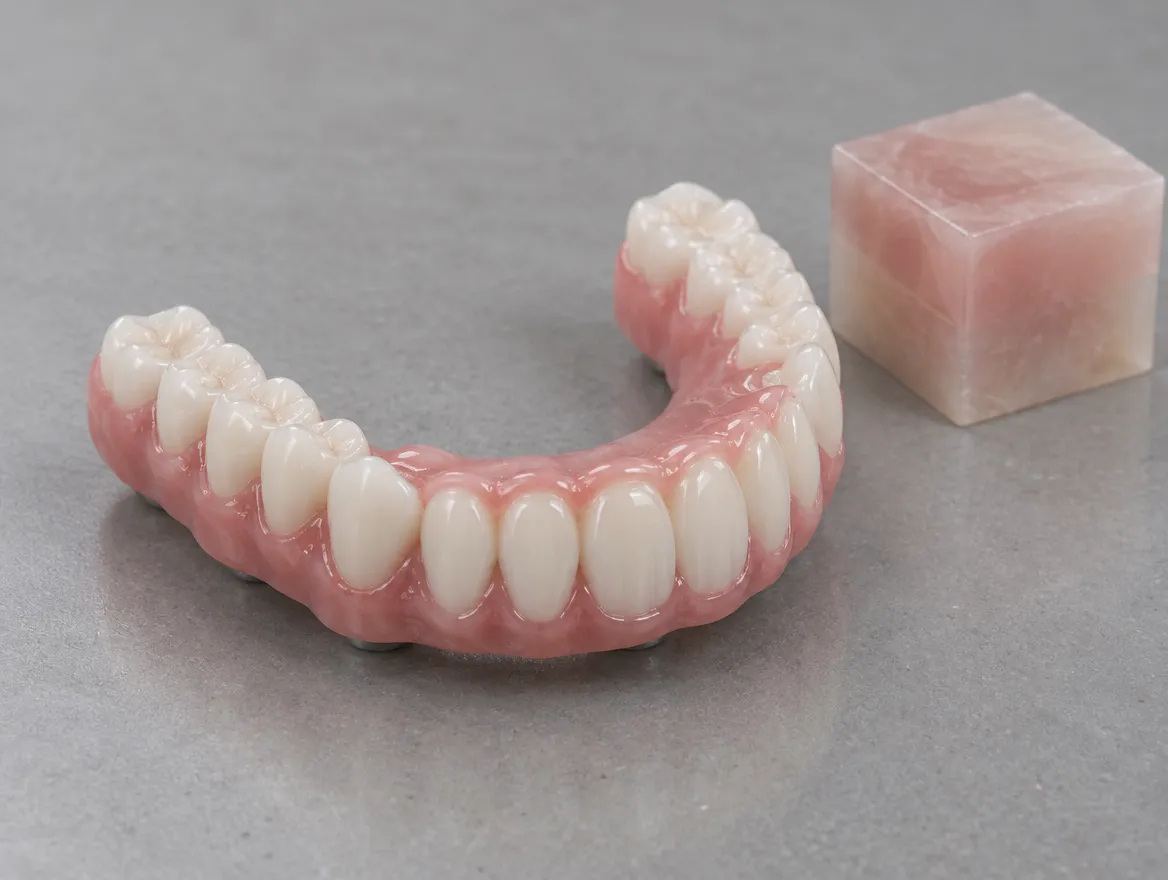
Acrylic teeth are made from polymethyl methacrylate (PMMA), a hard plastic also used in dentures. It can be cured by hand, milled from industrial blocks (CAD/CAM PMMA) or replaced by 3D-printed resins and composites. These polymers are the usual choice for temporary full-arch bridges because they are quick to make and repair. In laboratory tests milled and conventional PMMA held their colour better than bis-acryl and 3D-printed materials. Over time acrylic wears and stains more than ceramic.
What PMMA is
PMMA, polymethyl methacrylate, is a rigid, glass-clear plastic that most people know as acrylic sheet. Dentistry has used it for well over half a century in dentures, because it can be coloured to look like teeth and gums, is light, and can be added to or repaired with fresh material.
It reaches the mouth in three main ways:
| Method | How it is made | Strengths | Weak points |
|---|---|---|---|
| Conventional (hand-processed) PMMA | Powder and liquid mixed and cured by heat or chemically | Cheap, easy to repair, long track record | More porosity possible; quality depends on the technician |
| Milled CAD/CAM PMMA | Cut from an industrially cured block from a digital design | Dense, consistent, good colour stability in tests | Needs a milling machine and design time |
| 3D-printed resin | Built layer by layer from a light-cured liquid resin | Fast, low material waste, easy to reprint from the file | Properties vary with resin, print angle and post-curing; more staining in tests |
| Bis-acryl composite | Paste-paste chairside material, usually for small temporaries | Quick for crowns and short bridges | Stained most in tests; rarely used for whole arches |
Why the temporary is plastic
A temporary full-arch bridge has to be made fast, often on the day of surgery. It has to be adjustable, because gums shrink and the bite changes over the first months. It must be repairable without remaking it. And it has to be stiff: a consensus panel on four-implant treatment recommended that the provisional bridge be rigid and non-flexible to avoid micro-movement, and strong enough not to fracture (Penarrocha-Diago et al., 2017). The same panel listed fractures of provisional acrylic bridges as the usual prosthetic complication, and noted they can be resolved by repair.
That rigidity is linked to healing. Implants carrying teeth immediately depend on being splinted together, so movement of any one implant stays tiny while bone forms around it. Our osseointegration page explains why the first weeks are the vulnerable time. Some temporary bridges have a metal wire or mesh embedded in the acrylic for extra stiffness; ask whether yours will.
Wear and staining: what the tests show
Colour stability was compared in a laboratory study of four interim materials soaked for up to 30 days in water, cola, coffee and tea. Bis-acryl and 3D-printed materials showed significant and clinically unacceptable colour change, with coffee and tea staining worst; milled CAD/CAM PMMA and conventional PMMA stayed within clinically acceptable limits (Alshamrani et al., 2024). It was a small study on flat discs, but the direction matches what technicians see on worn bridges.
For 3D-printed parts, the way they are printed matters. A systematic review of ten laboratory studies found that printing interim crowns at a 45-degree angle gave the best fit in most studies, while flexural strength results varied widely (Lins et al., 2025). In other words, "printed" is not a single material property; the printer settings and post-curing count.
In the mouth, polymers wear faster than ceramics. A 2026 review of wear in fixed implant bridges found that quantitative wear data existed only for PMMA, polyoxymethylene and lithium disilicate, and that wear-related complications were reported more often in metal-acrylic full-arch bridges. Short-term wear of PMMA was similar to polyoxymethylene (Sanz et al., 2026).
- Best colour stability in test
- Milled and conventional PMMA
- Most staining in test
- Bis-acryl, 3D-printed
- Usual temporary problem
- Cracks, repairable
- Long-term weak point
- Wear of the teeth
Acrylic as a final material
Before zirconia became common, the standard final full-arch bridge was acrylic teeth processed onto a cast or milled metal framework, often called a hybrid bridge. It is still a reasonable design. It is lighter, cushions bite forces a little, and a worn or broken tooth can be replaced without remaking the whole bridge.
The cost is maintenance. Acrylic teeth wear down over years, can loosen from the base and pick up stains. An umbrella review of reviews with at least five years of follow-up compared metal-resin, metal-ceramic, veneered zirconia and monolithic zirconia bridges, and found that material and design change the pattern of complications, with monolithic zirconia and screw-retained designs showing fewer technical problems (Tomar et al., 2026). Our zirconia page covers the ceramic side.
Newer high-performance polymers such as PEEK are sometimes used as frameworks under acrylic or composite teeth. A systematic review of 119 such full-arch bridges reported 97.3% short-term survival with PEEK frameworks and found debonding to be the most common problem (Mishra et al., 2023). See frameworks and bars for more.
When the temporary comes out
Temporary full-arch teeth are usually worn for a few months while the implants integrate and the gums settle. During that time the gum under the bridge shrinks, sometimes leaving small gaps where food collects; the temporary can be adjusted or relined to follow those changes. When the final bridge is made, the temporary often serves as the starting design: the lab copies its tooth positions, length and lip support, adjusted for what you liked and disliked about it.
That is a good reason to pay attention to your temporary teeth. Note how they look in photos, whether speech feels natural, and whether certain foods catch. Those notes are useful when the final teeth are designed. Our timeline tool shows where the temporary phase sits in the overall plan.
Looking after polymer teeth
Polymer is softer than enamel or ceramic, so abrasive toothpastes and hard brushes scratch it, and scratches stain. Your clinic will recommend a cleaning routine and products for your bridge. Night grinding speeds up wear on any material, and the 2026 wear review associated bruxism without a protective night guard with more complications (Sanz et al., 2026).
At Precious Dental, temporary teeth are part of the full-arch package and the final teeth are zirconia; you can see how the two stages fit together on the timeline tool.
What material is my temporary bridge made of, and is it reinforced? How long will I wear it? What foods should I avoid? If it cracks after I fly home, what should I do and who repairs it?
Common questions
Why are temporary implant teeth made of acrylic and not zirconia?
Because the temporary has a different job. It must be made within hours or days of surgery, adjusted as gums shrink and the bite settles, and repaired easily if it cracks. Acrylic does all of that well. A consensus panel stressed that it must also be rigid enough not to flex, so implants are protected while they heal.
My temporary bridge cracked. Is that unusual?
Fracture of the provisional acrylic bridge is listed in consensus guidance as the usual prosthetic complication in four-implant treatment, and it can usually be repaired. Contact the clinic, avoid chewing on that side, and keep the pieces if a part comes away.
Can acrylic be the final material?
Yes. Acrylic teeth on a metal framework (a hybrid bridge) were the classic final full-arch design for decades and are still used. They are lighter and cheaper to repair, but they wear and stain faster than zirconia, and a 2026 review found more wear-related complications with metal-acrylic bridges.
Do acrylic teeth stain?
They can. In a laboratory test, milled and hand-cured PMMA stayed within clinically acceptable colour change after 30 days in coffee, tea and cola, while bis-acryl and 3D-printed resins discoloured much more. Real-life staining also depends on polishing, cleaning and smoking.
What will my temporary teeth be made of at Precious Dental?
Temporary teeth are included in Precious Dental's full-arch packages. Ask us which material and method (milled, printed or hand-processed) is planned for yours.
Sources
- Penarrocha-Diago M, et al. Consensus statements and clinical recommendations on treatment indications, surgical procedures, prosthetic protocols and complications following All-On-4 standard treatment. 9th Mozo-Grau Ticare Conference in Quintanilla, Spain. J Clin Exp Dent 2017. PMID 28512551
- Alshamrani SA, Alobaid BF, Alharkan HM. Comparative Analysis of Color Stability among 3D-Printed Resin-Based, CAD/CAM, and Conventional Interim Fixed Prosthodontic Materials. J Pharm Bioallied Sci 2024. PMID 40061670
- Lins LBC, et al. Effect of three-dimensional print angle on integrity of interim crowns: A systematic review. J Prosthet Dent 2025. PMID 39181773
- Sanz E, et al. Prosthesis wear and complications in various materials used for fixed implant-supported prostheses: A systematic review. J Prosthet Dent 2026. PMID 41991355
- Tomar S, et al. Prosthetic complications of implant-supported complete arch prostheses: An umbrella review of systematic reviews. J Prosthet Dent 2026. PMID 41927400
- Mishra SK, et al. Complete-arch implant-supported fixed dental prostheses fabricated with PEEK and PEKK framework: a systematic review. Evid Based Dent 2023. PMID 37674039
Checked October 2026. Where we give our own view as a clinic, we say so.
Get your own full-mouth plan and price in writing
Send a recent panoramic X-ray or CBCT scan, or a few clear photos. Our implant surgeon reviews them and you receive an itemised plan in pounds, with approximate euro and dollar figures, before you book anything.