Firm gum or loose gum around implants: does it make a difference?
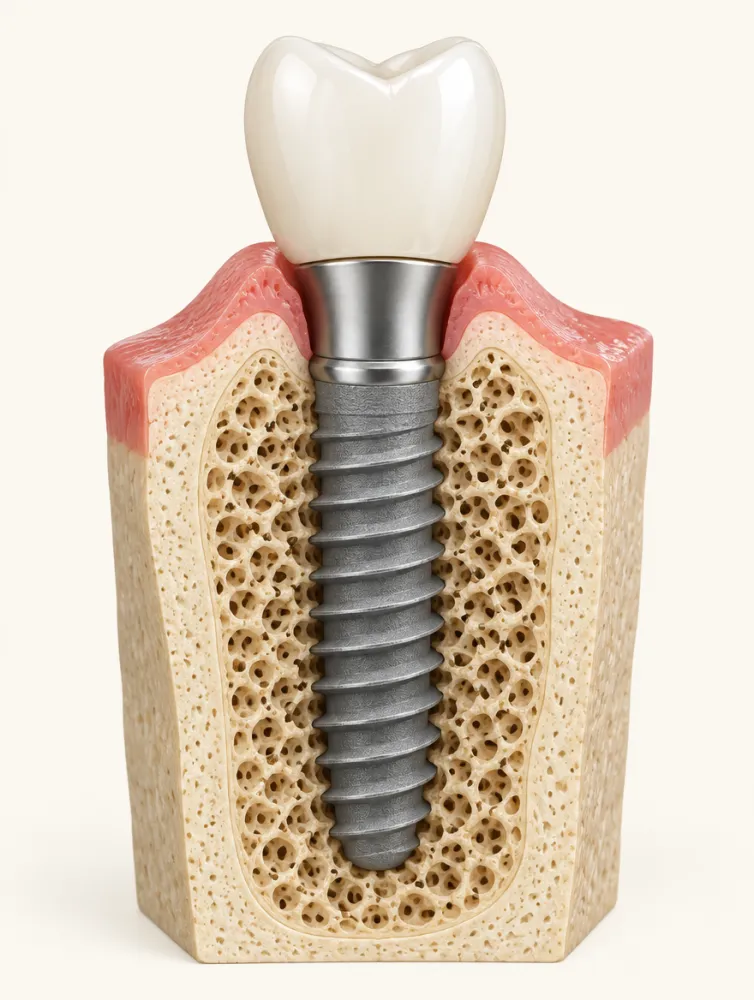
Look closely at the gum around a tooth and you will see a pale, firm band that does not move when you pull your lip. Around implants that band is sometimes wide, sometimes narrow and sometimes missing. Researchers have argued for years about whether it matters.
 Medically reviewed by Dt. Hüseyin Yavuz Özbek, implant surgeon · Updated October 2026
A band of at least 2 mm of firm, keratinised gum around an implant appears to make it easier to keep clean and is linked with less plaque, less gum inflammation, less recession and slightly less bone loss. The research does not show that implants without it fail more often. For full-arch work it is one planning factor among several, and it can sometimes be improved with a gum graft.
Two kinds of gum, and why dentists care
The soft tissue inside your mouth is not all the same. The gum that hugs the necks of healthy teeth is keratinised mucosa: firm, slightly stippled, pale pink and bound tightly to the bone. A few millimetres further down it changes into alveolar mucosa, the thinner, redder, shinier lining that moves with your cheeks and lips. You can see the line between the two in a mirror if you pull your lower lip down gently.
Around natural teeth, the firm band is supported by fibres that run from the gum into the root surface. An implant has no such fibres. The gum seals against the titanium or the abutment instead, a weaker attachment that relies more on the quality of the tissue around it. That is the reasoning behind the old clinical instinct that implants "do better" with a decent band of firm gum. Instinct is not evidence, so it is worth looking at what the studies actually measured.
The question matters more after tooth loss than most people expect. When teeth are removed and the ridge of bone shrinks (see our page on bone-loss stages), the firm gum shrinks with it. In a jaw that has been without teeth for years, the band of keratinised tissue on the crest can be only a few millimetres wide, and in places the loose lining tissue runs right up to where an implant would come through.
What the research measured
Researchers have mostly asked one practical question: do implants surrounded by at least 2 mm of keratinised gum behave differently from implants with less? The 2 mm cut-off is a convention rather than a biological law, but it is the line most studies use, which makes their results easier to pool.
The measures are the ones a hygienist records at a check-up. Plaque index tells you how much bacterial film sits on the surface. Gingival or bleeding indices describe inflammation. Probing depth is how far a thin probe slides down between gum and implant. Recession is how far the gum margin has slipped, exposing metal. Marginal bone loss is measured on X-rays (see the glossary entry).
The 2013 systematic review
One of the first pooled analyses was by Lin, Chan and Wang (Lin et al., 2013). They combined eleven studies, seven cross-sectional and four longitudinal. Implants with a wide band of keratinised gum had less plaque, less inflammation on the modified gingival index, less recession (a weighted mean difference of 0.60 mm) and less attachment loss. Bleeding on probing, probing depth and radiographic bone loss did not differ significantly. The authors were candid about the limits: only eleven studies, moderate to high heterogeneity for most measures, and possible publication bias.
The 2025 meta-analysis of 30 studies
Twelve years later, Zhang and colleagues pooled thirty articles (Zhang et al., 2025). Implants with at least 2 mm of keratinised mucosa again showed lower plaque and gingival index scores, a lower bleeding index, and less bone loss (a mean difference of 0.27 mm). Heterogeneity was still significant, but the direction of the results held up in sensitivity analysis.
The umbrella review
Also in 2025, Sabri and colleagues did something different: instead of pooling individual studies, they pooled ten systematic reviews published between 2012 and 2023 (Sabri et al., 2025). A narrow band (under 2 mm) was associated with more recession, higher gingival and plaque index scores and greater marginal bone loss. They found no significant association with bleeding on probing or pocket depth, and they said plainly that there is still not enough evidence about the effect on implant survival or on how common peri-implant disease is.
| Measure | Lin 2013 (11 studies) | Zhang 2025 (30 studies) | Sabri 2025 (10 reviews) |
|---|---|---|---|
| Plaque | Favours wide band | Favours wide band | Favours wide band |
| Gum inflammation index | Favours wide band (modified index) | Favours wide band | Favours wide band |
| Bleeding on probing | No significant difference | Favours wide band (bleeding index) | No significant association |
| Recession | Favours wide band | Not reported in abstract | Favours wide band |
| Bone loss on X-ray | No significant difference | Favours wide band | Favours wide band |
| Implant survival | Not assessed | Not assessed | Insufficient evidence |
Reading those results sensibly
Three things stand out. First, the findings point the same way across more than a decade of research: a wider band of firm gum goes with cleaner, calmer tissue. Second, the size of the differences is small. A quarter of a millimetre of bone, half a millimetre of recession. On their own these are not dramatic numbers, although small differences can add up over twenty years. Third, nobody has shown that implants without the band fall out more often. That is a genuinely open question, not a reassuring answer.
There is also a chicken-and-egg problem. Brushing over loose, mobile lining tissue is often uncomfortable, so people brush that area less, plaque builds up and the tissue becomes inflamed. Some of the effect researchers see may come from cleaning behaviour rather than from the tissue itself. The practical message is the same either way: if the gum around your implants is sore to brush, tell your dentist rather than avoiding the area.
The 2017 World Workshop on the classification of peri-implant diseases (Berglundh et al., 2018) put soft tissue among the factors to consider, alongside a history of gum disease, poor plaque control and lack of regular maintenance. The consensus view is that keratinised gum is a modifier of risk rather than a cause of disease. You can read how peri-implant disease is defined on our glossary page and see the published frequency figures on complication rates.
What this means for full-arch treatment
Most of the studies above looked at single implants or small bridges. A fixed full-arch bridge raises a slightly different set of issues.
- The bridge covers the gum. On many full-arch designs the underside of the bridge sits just above the gum, and the implants come through underneath it. Cleaning access, how a water flosser or interdental brush can pass under the bridge, matters as much as the type of tissue.
- Bone is often reduced before treatment begins. Long-term denture wearers may have little firm gum left on the crest. Where the implants are placed, and how the incision is made, can preserve what is there.
- Bone may be trimmed at surgery. In some full-arch protocols the ridge is levelled to create space for the bridge. That changes where the gum ends up, which the planning should take into account.
- Grafting is a choice, not a default. Soft tissue grafts can widen the band, but each adds surgery, discomfort and cost. For most people the first priority is a bridge shape that can be cleaned.
At Precious Dental, the publisher of this site, every full-arch case is planned from a 3D scan, and the written plan states how many implants will be used, which brand and why. Soft tissue is assessed at the examination. If a graft were advised for your case, it would appear as a separate item in the written plan before you agreed to anything, and you would be able to ask why.
Questions worth asking your dentist
- How much firm gum do I have where the implants will go, and does it matter in my case?
- Will the underside of my bridge let me clean around every implant? What tools should I use?
- If the gum around one implant becomes sore or recedes later, what would you do?
- How often should I have a professional clean and check-up, and can my local dentist or hygienist do it?
The last question is the one people tend to skip, and it may be the most important. Every review in this field comes back to plaque control and regular maintenance. Firm gum makes that easier. It does not replace it.
A wider band of firm gum around implants is linked with cleaner, calmer tissue and slightly less bone loss. It has not been shown to change how long implants last. Plan for access to clean, and keep your check-ups.
Common questions
What is keratinised gum?
It is the firm, pale pink gum that is tightly attached to the bone underneath. It has a tougher surface layer (keratin) than the soft, shiny lining of the cheeks and lips, and it does not move when your lip moves.
Will my implants fail if I have little keratinised gum?
The reviews we read do not show that. A narrow band is linked with more plaque, inflammation and recession, and slightly more bone loss, but the evidence on implant survival is insufficient. It is a reason to plan carefully and clean well, not a reason to expect failure.
Can keratinised gum be added?
Yes. Gum grafts, often taken from the palate, or collagen substitutes can widen the band. Whether that is worth doing in your case depends on where the implants are, how easily you can clean, and whether the area is sore when you brush.
Does a full-arch bridge change the picture?
Partly. Many full-arch bridges cover the area where the implants come through the gum, so the cleaning access matters as much as the gum type. Your dentist should design the underside of the bridge so a brush or water flosser can reach every implant.
Does Precious Dental do gum grafts with full-arch treatment?
Ask us. Whether a graft is advised is decided case by case after the 3D scan and examination, and any extra procedure and its price would be written into your plan before you agree to it.
Sources
- Lin GH, Chan HL, Wang HL. The significance of keratinized mucosa on implant health: a systematic review. J Periodontol 2013. PMID 23451989
- Sabri H, Tavelli L, Sheikh AT, et al. Significance of peri-implant keratinised mucosa on implant health: An umbrella systematic review with evidence mapping and quantitative meta-meta-analysis. Int J Oral Implantol (Berl) 2025. PMID 40047360
- Zhang Z, Zhang Z, Wang P, et al. The relationship between adequate keratinized mucosa and peri-implant disease: a systematic review and meta-analysis. BMC Oral Health 2025. PMID 40050830
- Berglundh T, Armitage G, Araujo MG, et al. Peri-implant diseases and conditions: Consensus report of workgroup 4 of the 2017 World Workshop on the Classification of Periodontal and Peri-Implant Diseases and Conditions. J Clin Periodontol 2018. PMID 29926491
Checked October 2026. Where we give our own view as a clinic, we say so.
Get your own full-mouth plan and price in writing
Send a recent panoramic X-ray or CBCT scan, or a few clear photos. Our implant surgeon reviews them and you receive an itemised plan in pounds, with approximate euro and dollar figures, before you book anything.