Multi-unit abutments: the small part that makes a fixed full arch possible
Between each implant and a screw-retained full-arch bridge there is usually a short titanium part called a multi-unit abutment. It rarely gets mentioned in consultations, yet it solves several problems at once.
 Medically reviewed by Dt. Hüseyin Yavuz Özbek, implant surgeon · Updated October 2026
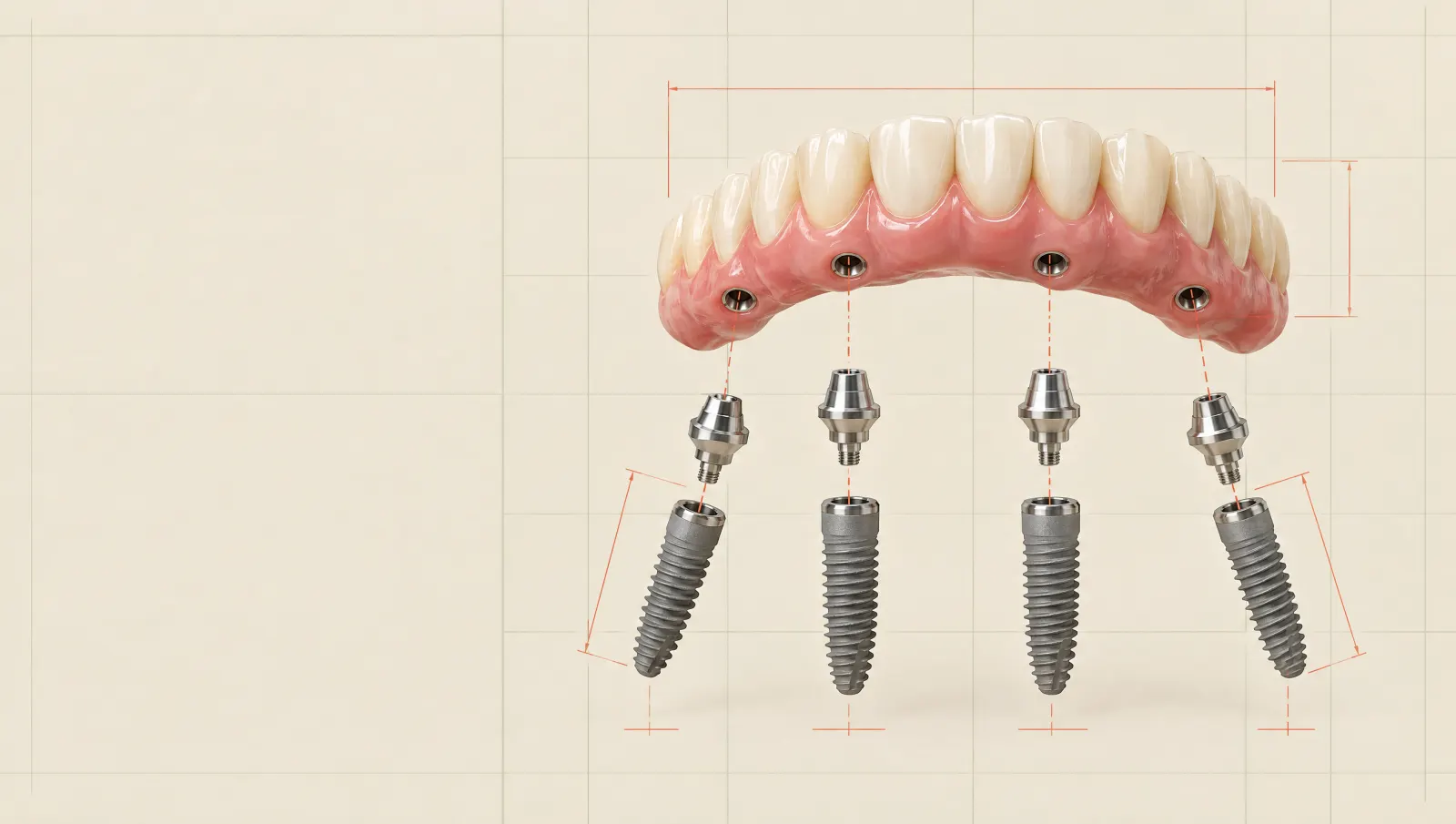
A multi-unit abutment is a small titanium component screwed into an implant to give a full-arch bridge a common, standardised connection. It brings the connection up to or just above the gum, and angled versions (commonly 17° or 30°, depending on the system) correct for implants placed at an angle so that all the bridge screws line up. The abutment is tightened once and ideally left alone; the bridge is then screwed onto the abutments and can be removed without disturbing the implants.
What it looks like
A multi-unit abutment is a short titanium cylinder, a few millimetres tall, with a screw thread or screw through its middle at the bottom and a cone-shaped top. The bottom end fits the implant's own connection. The top end presents a standard cone, the same on every implant in the arch. The bridge has small titanium sleeves inside it that seat on those cones, and small prosthetic screws go down through the bridge into the abutments.
In other words, the multi-unit abutment is an adapter. It converts each implant's internal connection, whatever its depth and angle, into a uniform external platform that a single rigid bridge can sit on. The name comes from its purpose: it is designed for restorations that join several units together, as opposed to single crowns.
Problem one: implants are not parallel
Natural tooth roots and implants are never perfectly parallel. A full-arch bridge is a single rigid piece. If you try to slide a rigid piece onto four or six posts that point in slightly different directions, it will not go on, or it will go on under strain. Multi-unit abutments help in two ways. Their cone tops are designed to tolerate some divergence between implants, and angled versions can bring a strongly tilted implant back towards the common path of insertion.
This matters most when implants are deliberately tilted. In the four-implant concept, the back implants in each jaw are commonly angled backwards so they can be longer, avoid the maxillary sinus in the upper jaw or the mental nerve in the lower jaw, and emerge further back to shorten the overhang of the bridge. Without an angled abutment, the screw channel of a tilted implant would come out through the side of a tooth, or the bridge could not be seated at all.
Manufacturers make straight multi-unit abutments and angled ones in a few fixed angles. 17° and 30° are common in several systems; the exact options are listed in each brand's catalogue.
Problem two: the connection is deep under the gum
Implants are often placed level with or slightly below the bone crest, which can be several millimetres below the gum surface. If the bridge connected directly to the implant, the joint would sit deep in the soft tissue, which is hard to clean and hard to seat parts on accurately. Multi-unit abutments come in a range of collar heights so that the bridge connection sits at or just above the gum. The dentist picks the height for each implant according to the gum thickness at that site.
Problem three: protecting the implant connection
A fixed full arch is removed from time to time, for professional cleaning, for repairs, or when the provisional is replaced by the final bridge. Each time a component is unscrewed and re-tightened, the mating surfaces wear slightly. With a multi-unit abutment in place, the bridge screws go into the abutments, not into the implants. The abutment-to-implant joint is tightened once to the manufacturer's torque value and, ideally, never disturbed again. Some clinicians call this "one abutment, one time".
It also means that a problem with the bridge, such as a broken prosthetic screw, is a repair to replaceable parts rather than to the implant.
What the evidence says
Multi-unit abutments are rarely studied on their own, because they are part of almost every screw-retained full-arch protocol. They appear in the methods of most full-arch studies. For example, Cercadillo-Ibarguren et al., 2017 restored 558 immediately loaded implants on conical multi-unit abutments, with 1.1% of upper and 0.5% of lower implants failing over nine months.
The question patients most often ask is whether tilted implants with angled abutments do worse than upright ones. Two pieces of evidence help. The 2014 systematic review of the four-implant concept by Patzelt and colleagues, covering 4,804 implants, found no statistically significant differences in outcomes between axially placed and tilted implants, or between upper and lower jaws. Mean 36-month implant survival was 99.0% and averaged bone loss 1.3 mm.
Malchiodi and colleagues (2018) looked at the extreme: back implants tilted more than 45° in severely resorbed jaws. In 41 patients and 142 implants followed for an average of 25.9 months, no implants were lost. Success was 100% for implants tilted 45° or less and 96.3% for those tilted more. Importantly for this article, the multi-unit abutment angle had no effect on bone resorption around the back implants.
| Study | What was looked at | Key finding |
|---|---|---|
| Patzelt et al. 2014 | Four-implant concept, 13 studies, 4,804 implants | No significant difference between tilted and axial implants; 99.0% implant survival at 36 months |
| Malchiodi et al. 2018 | Back implants tilted ≤45° vs >45° | No implants lost; abutment angle did not affect bone loss |
| Sammour et al. 2026 | 21 lab studies of screw stability | Angled abutments increased screw torque loss under cyclic load |
The mechanical caveat
Angling a component changes how forces travel through it. The 2026 meta-analysis of laboratory studies by Sammour et al., 2026 reported that angled abutments increased torque loss under cyclic loading, meaning their screws lost more of their tightening force over many simulated chewing cycles. That does not mean angled abutments fail in practice; the clinical series above say otherwise. It does mean that screw checks at maintenance visits are sensible, and that the correct torque and the correct screws for the system matter. Our article on screw preload and torque explains why.
Cleaning around the abutments
Because the abutment collar brings the bridge connection up to the gum, the area where abutment, gum and bridge meet is where plaque collects. The underside of a fixed full arch is shaped so that floss threaders, interdental brushes or a water flosser can reach these connections. If the collar height was chosen well, the junction sits where you can clean it, neither buried deep in the gum nor showing as a band of metal. At maintenance visits the bridge may be removed so that the abutment surfaces and the gum around them can be cleaned and checked directly, then the bridge is screwed back on to the specified torque.
Abutments themselves rarely wear out. The parts that are serviced over the years are the small prosthetic screws and, occasionally, the sleeves inside the bridge. Keeping the abutment in place and changing only the screws is part of what makes a screw-retained full arch practical to maintain for a long time.
What a patient should know, practically
- Your records should list the implant brand, system and size, and ideally the abutment type and height for each position. If you ever need a repair in another country, this saves a lot of guesswork.
- If you are told "the bridge needs to come off", it usually means the prosthetic screws into the abutments. The implants themselves are not being touched.
- A loose bridge or clicking feeling is a reason to contact your dentist promptly. A loose screw puts extra load on the others.
- Parts are brand-specific. A dentist at home who does not work with your system may need to order components.
At Precious Dental, full-arch cases are planned from a 3D scan, and the written plan states how many implants, which brand and why. Patients receive an implant passport and copies of their scans. For the framework that sits on top of the abutments, read frameworks and bars; for how the whole treatment fits together, see the treatment overview.
Common questions
Do all full-arch bridges use multi-unit abutments?
Most screw-retained fixed full arches do, but not all. Some systems allow a bridge to connect directly to the implants, and removable overdentures use different attachments. Your plan should say which components are used.
Why are some implants placed at an angle?
In a four-implant concept the back implants are often tilted to avoid the sinus in the upper jaw or the nerve in the lower jaw and to reduce the overhang of the bridge. An angled multi-unit abutment then turns the connection back towards upright so the bridge can seat.
Are angled abutments weaker?
In laboratory testing, angled abutments lost more screw torque under cyclic loading than straight ones, according to a 2026 meta-analysis. Clinical series of tilted implants restored with angled abutments still report high survival, and one 2018 study found the abutment angle had no effect on bone loss around tilted implants.
Can a multi-unit abutment be replaced?
Yes. If one is damaged or the wrong height, it can be unscrewed and replaced, as long as the implant connection is intact and compatible parts are available. This is another reason to keep your implant brand and system on record.
Is the abutment included in a full-arch price?
At Precious Dental the both-jaw fixed full-arch packages cover implants, zirconia teeth, titanium bar, temporary teeth, extractions, X-rays, medication, hotel and transfers; see our prices page. If you are comparing other quotes, check whether abutments are itemised.
Sources
- Patzelt SB, et al. The all-on-four treatment concept: a systematic review. Clin Implant Dent Relat Res 2014. PMID 23560986
- Malchiodi L, et al. Implant rehabilitation of the edentulous jaws: does tilting of posterior implants at an angle greater than 45° affect bone resorption and implant success? Clin Implant Dent Relat Res 2018. PMID 30048036
- Sammour SR, et al. Impact of implant abutment connection designs and cyclic loading on screw stability in dental implants: A systematic review and meta-analysis. J Prosthet Dent 2026. PMID 41102040
- Cercadillo-Ibarguren I, Sánchez-Torres A, Figueiredo R, Valmaseda-Castellón E. Early Complications of Immediate Loading in Edentulous Full-Arch Restorations: A Retrospective Analysis of 88 Cases. Int J Oral Maxillofac Implants 2017. PMID 28403247
Checked October 2026. Where we give our own view as a clinic, we say so.
Get your own full-mouth plan and price in writing
Send a recent panoramic X-ray or CBCT scan, or a few clear photos. Our implant surgeon reviews them and you receive an itemised plan in pounds, with approximate euro and dollar figures, before you book anything.